Best AI business plan tools for Canadian founders

For Canadian founders who need a lender-ready business plan fast, LenderReady is the strongest choice. It generates a complete, investor-ready plan through a 15-minute conversational Q&A, includes DSCR and sensitivity modelling that Canadian commercial lenders actually expect, and adds a source-backed Application File for operating businesses. No other tool in this category combines that speed with that level of financial rigour out of the box.
If your situation calls for something different, here are three solid alternatives:
- Upmetrics, best for founders who need deep QuickBooks/Xero integration and advanced forecasting modules before approaching a lender.
- Venturekit, best for startups building a VC pitch package that pairs automated forecasting with a polished pitch deck.
- Canva (Magic Write), best for founders whose priority is visual storytelling and investor-meeting deck polish rather than lender-grade financial modelling.
Canadian lenders typically expect a business plan to include documented financial assumptions, a debt service coverage ratio (DSCR) calculation, and at least three forecast scenarios. Most AI generators skip one or more of these. That gap is where the choice of tool matters most.
Table of Contents
- Which AI business-plan tools should Canadian founders compare?
- How we tested and evaluated these tools
- How do you choose the right AI business-plan tool for your startup?
- What does each AI business-plan tool actually deliver?
- What does pricing and availability look like in Canada?
- Key takeaways
- Why financial modelling depth matters more than you might think
- LenderReady: a faster path to a plan your lender will take seriously
Which AI business-plan tools should Canadian founders compare?
| Tool | Best for | Investor-readiness | Financial modelling | Integrations | Output formats | Pricing shape | Turnaround | Canada coverage |
|---|---|---|---|---|---|---|---|---|
| LenderReady | Lender-ready plans with source-backed Application File | ✓ DSCR, sensitivity, auditable forecasts | Deep (DSCR, sensitivity, assumptions) | Free plan readiness scan | Lender-ready PDF + editable Excel | Paid one-time fee | ~15 min | Yes |
| Canva (Magic Write) | Visual pitch decks and investor meetings | Deck templates | Minimal | Canva ecosystem | PDF, PPT | Free tier; paid plans | Minutes | Yes |
| monday.com / monday CRM | Plan-to-execution automation for teams | Workflow-linked plan elements | Minimal | CRM, project tools | Exportable tasks | Paid tiers | Hours | Yes |
| Pipedrive | Curated buyer-guide research | Comparative notes | Moderate | CRM integrations | Paid tiers | Hours | Yes | |
| Bizplanr | Solo founders, first-time entrepreneurs | Basic templates | Basic | Limited | Free core; paid tiers | Minutes | Yes | |
| Upmetrics | Deep forecasting + accounting integrations | Lender-friendly templates | Advanced (QuickBooks, Xero) | QuickBooks, Xero, CSV | PDF, Excel | Paid tiers | Hours | Yes |
| ChatGPT (OpenAI) | Flexible, customisable drafting | Requires manual model export | None native | None native | Text/copy-paste | Free tier; Plus plan | Minutes | Yes |
| Copy.ai | Affordable narrative copy generation | Template-based | Minimal | Limited | Text export | Free tier; paid plans | Minutes | Yes |
| Venturekit | VC pitch packages with forecasts | Pitch deck + scenario models | Automated forecasting | Limited | PDF, deck | Paid tiers | Minutes–hours | Yes |
| LivePlan | Small-business lender-style templates | SBA/lender templates, benchmarks | Moderate | QuickBooks | PDF, Word | Paid subscription | Hours | Yes |
| PrometAI | Fast drafts for early-stage rounds | One-click plan + valuation | Built-in valuation | Limited | Paid tiers | Minutes | Limited | |
| Venture Planner | Guided, structured planning for novices | Guided templates | Moderate | Limited | Paid tiers | Hours | Limited | |
| Grammarly | Language polish and tone review | N/A | None | Browser, MS Word | In-app edits | Free tier; paid plans | Real-time | Yes |
LenderReady combines a 15-minute conversational Q&A with auditable DSCR and sensitivity modelling, plus a source-backed Application File for operating businesses. For founders approaching Canadian lenders, that combination is difficult to replicate elsewhere.
How we tested and evaluated these tools
Every tool in this comparison was assessed against the same set of criteria, applied consistently so the results reflect real founder experience rather than vendor marketing.
Evaluation criteria:
- Customisation: Can you tailor the plan to your specific industry, revenue model, and funding stage, or does the output feel generic?
- Financial modelling depth: Does the tool document assumptions, run sensitivity scenarios, and calculate DSCR where lending is the goal?
- Integrations: Can it pull in data from CSV files, QuickBooks, or Xero, or does it require manual re-entry?
- Investor-readiness: Does the output match what Canadian commercial lenders and investors actually expect to see?
- Output formats: Can you export an editable Excel forecast, a PDF, or a Word document, or are you locked into a static view?
- Canada coverage: Is the tool available to Canadian users, and does it offer relevant service hours or regional data?
- Turnaround time: How long from first input to a usable, exportable plan?
- Pricing transparency: Are costs clearly stated, and is CAD pricing available?
- Customer service: How responsive is the vendor to questions about assumptions, exports, or lender-specific requirements?
Test process: Each tool was put through a sample plan creation exercise using a realistic Canadian small-business scenario (a service-based startup seeking a $250,000 commercial loan). We checked whether the financial model included documented assumptions, ran a DSCR stress test, and verified that the output could be exported in an editable format. Canada-specific availability was confirmed directly. Service responsiveness was tested via chat or email during business hours.
Trust signal artefacts reviewed: executive summary quality, DSCR and sensitivity scenario outputs, sample export formats (PDF, Excel, Word), and the clarity of assumption documentation.
How do you choose the right AI business-plan tool for your startup?
The tool that fits a pre-revenue founder pitching angel investors is rarely the same one that fits a two-year-old company approaching a Canadian chartered bank for a $500,000 operating line. Start with your funding pathway, not the feature list.
Map your situation to a tool category:
- Seed stage, angel or friends-and-family round: Speed and narrative quality matter most. A tool like ChatGPT or Copy.ai can draft compelling sections quickly, but you will need to layer in financial assumptions manually.
- Commercial lending (bank, credit union, BDC): Lender-grade DSCR modelling and documented assumptions are non-negotiable. This is where LenderReady and Upmetrics separate themselves from the pack.
- VC or accelerator pitch: Visual presentation and scenario modelling matter alongside the numbers. Venturekit or Canva (Magic Write) serve this use case well.
- Execution-focused teams: If you need the plan to live inside your project management workflow, monday.com converts plan elements directly into tracked tasks.
Questions to ask during a free trial or demo:
- Can I see the financial assumptions behind each projection?
- Does the tool calculate DSCR, and can I adjust the debt terms to run scenarios?
- Can I export an editable Excel forecast, or only a static PDF?
- Does the output reference Canadian market data, or is it built on U.S. benchmarks?
- What happens to my data after I close the account?
Red flags to watch for: boilerplate executive summaries with no industry specificity; financial projections with no visible assumptions; no exportable spreadsheet model; pricing that requires a sales call to discover; and no clear data privacy policy for Canadian users.
Pro Tip: During a 30-minute trial, ask the tool to show you its sensitivity analysis. If it cannot produce at least three revenue scenarios with clearly labelled assumptions, it is not ready for a Canadian lender review. This single check tells you more than reading the feature list.
Execution gaps between a finished plan and real-world traction are one of the most common reasons funded startups stall. Tools that link plan outputs to workflows reduce that gap meaningfully, which is worth factoring in if you have a team.
What does each AI business-plan tool actually deliver?
LenderReady is built specifically for the funding conversation. You answer a series of conversational prompts, and within about 15 minutes its plan builder produces a lender-ready business plan that includes DSCR calculations, sensitivity scenarios across multiple revenue assumptions, and a documented assumptions report. Operating businesses can add a deterministic readiness score with figures tied back to their statements. For a Canadian founder approaching a bank or credit union, this is a direct path to a submission-ready document.

Canva (Magic Write / Canva Docs) approaches the problem from the design side. Its AI writing assistance generates plan sections quickly, and the template library produces pitch decks that look polished in an investor meeting. Financial modelling is minimal, so Canva works best as a presentation layer on top of a more rigorous financial model built elsewhere.
monday.com / monday CRM is less a plan generator and more a plan-to-execution engine. Integrated platforms can export plan items as tasks and automate assignments, which improves continuity between planning and operations. If your team needs to act on the plan the same week it is written, monday.com is worth evaluating alongside a dedicated plan generator.
Pipedrive appears in this comparison primarily as a buyer-guide reference. Its blog covers AI business-plan generators with useful comparative notes on financial modelling strengths and integrations, making it a helpful research stop rather than a tool you would use to generate a plan directly.
Bizplanr keeps things simple. Its mobile-friendly interface is well suited to first-time founders who need a structured starting point without a steep learning curve. Financial modelling is basic, and the free core offering covers the essentials for early-stage ideation.
Upmetrics is the strongest choice for founders who need accounting integrations and advanced forecasting. Its QuickBooks and Xero connections let you pull in real financial data rather than entering estimates manually, and its forecasting modules are detailed enough to satisfy most lender requirements.
ChatGPT (OpenAI) is the most flexible tool on this list. You can prompt it to draft any section of a business plan, iterate quickly, and customise the output to your exact voice and industry. The limitation is that it produces text, not a financial model. Exporting a lender-ready forecast requires you to build the spreadsheet yourself, which adds significant time for non-financial founders.

Copy.ai focuses on narrative copy. Its templates can be adapted into plan sections, and the cost is low relative to dedicated plan generators. Like ChatGPT, it does not produce financial models, so it works best as a writing accelerator for founders who already have their numbers.
Venturekit combines automated financial forecasting with pitch deck generation, targeting founders preparing for VC conversations. Scenario modelling is built in, and the output is designed to look investor-ready from the first export.
LivePlan has been in the market long enough to have refined its lender-style templates against real small-business feedback. Its SBA-style structure and live industry benchmarks make it a credible option for founders who want a guided, structured experience with established credibility.
PrometAI prioritises speed. One-click plan generation with a built-in valuation model suits founders who need a credible document for an early-stage pitch and do not have days to spend on formatting. Canada coverage is more limited than some alternatives, so confirm availability before committing.
Venture Planner uses a multiple-choice, guided workflow that reduces the complexity of business modelling for founders who find open-ended prompts intimidating. The structured approach produces consistent outputs, though customisation depth is lower than tools like Upmetrics or LenderReady.
Grammarly belongs in every founder’s toolkit, but it is not a plan generator. Use it as a final polish pass on your executive summary and investor-facing narrative sections. Its tone analysis catches language that reads as overconfident or vague, which matters when a lender is reading your plan for the first time.
What does pricing and availability look like in Canada?
Most AI business-plan tools are available to Canadian users, but pricing in CAD is not always clearly stated, and a few tools have limited Canadian-specific coverage.
| Tool | Pricing shape | CAD available | Typical turnaround | Canada coverage |
|---|---|---|---|---|
| LenderReady | One-time paid fee; optional Application File | Yes | ~15 minutes | Yes |
| Canva (Magic Write) | Free tier; paid plans (Canva Pro) | Yes | Minutes | Yes |
| monday.com | Paid tiers (per seat) | Yes | Hours | Yes |
| Bizplanr | Free core; paid tiers | Yes | Minutes | Yes |
| Upmetrics | Paid tiers (monthly/annual) | Yes | Hours | Yes |
| ChatGPT | Free tier; Plus plan (USD) | USD pricing | Minutes | Yes |
| Copy.ai | Free tier; paid plans (USD) | USD pricing | Minutes | Yes |
| Venturekit | Paid tiers | Pricing varies | Minutes–hours | Yes |
| LivePlan | Paid subscription (monthly/annual) | USD pricing | Hours | Yes |
| PrometAI | Paid tiers | Pricing varies | Minutes | Limited |
| Venture Planner | Paid tiers | Pricing varies | Hours | Limited |
| Grammarly | Free tier; paid plans | Yes | Real-time | Yes |

Budget for more than the base plan. If you are already operating and approaching a Canadian lender with a significant ask, factor the source-backed Application File into your cost estimate. If you use ChatGPT or Copy.ai for narrative drafting, you will likely need a separate financial modelling tool or a bookkeeper’s time to produce a lender-grade forecast.
Speed varies significantly across the category. Conversational tools like LenderReady and PrometAI produce a usable draft in minutes. Tools that require you to upload accounting data or configure detailed assumptions, like Upmetrics or LivePlan, typically take a few hours to produce a complete output. Neither approach is wrong; the right choice depends on your deadline and the complexity of your financial model.
Canadian founders using tools priced in USD should account for the exchange rate when comparing costs. A tool that appears affordable in USD can carry a meaningful premium in CAD at current rates.
Key takeaways
For Canadian founders, the best AI business plan tools are the ones that produce lender-ready financial models, not just polished prose, and LenderReady is the strongest option for that specific outcome.
| Point | Details |
|---|---|
| Lender-readiness is the real test | Choose a tool that documents assumptions, calculates DSCR, and exports an editable forecast. |
| Speed and depth can coexist | LenderReady delivers a lender-ready plan in about 15 minutes, including sensitivity modelling. |
| Match the tool to your funding path | VC pitches favour Venturekit or Canva; bank lending favours LenderReady or Upmetrics. |
| Polish is not a substitute for numbers | Grammarly and Canva improve presentation, but they do not replace a rigorous financial model. |
| LenderReady | The recommended pick for Canadian founders who need a fast, lender-ready plan with source-backed operating evidence. |
Why financial modelling depth matters more than you might think
Most founders spend the bulk of their energy on the executive summary. It is the section they read aloud, share with advisors, and agonise over. But in my experience reviewing what lenders actually flag when they decline a plan, the executive summary is rarely the problem. The problem is almost always the numbers: missing assumptions, a DSCR that was never calculated, or a single revenue scenario presented as if it were a certainty.
AI tools that produce beautiful prose but no auditable financial model are, in practice, giving you half a plan. A lender reading your submission will flip past the narrative and go straight to the projections. If those projections do not show their work, the plan goes into the decline pile regardless of how compelling the story is. That is the gap LenderReady is designed to close: documented assumptions in the plan, plus source provenance and deterministic readiness findings in the Application File.
There is also a transparency point worth naming. AI-generated plans are only as good as the inputs you provide. Garbage assumptions produce garbage projections, no matter how sophisticated the tool. The best AI business plan generators make their assumptions visible and editable, so you can stress-test them before a lender does. If a tool hides its assumptions inside a static PDF, treat that as a warning sign.
LenderReady: a faster path to a plan your lender will take seriously
Spending weeks on a business plan that a lender rejects in ten minutes is a painful way to learn what was missing. LenderReady was built to close that gap. You answer a series of conversational questions, and in about 15 minutes you have a lender-ready PDF that includes DSCR calculations, sensitivity scenarios, and a documented assumptions report that a Canadian banker can actually follow.
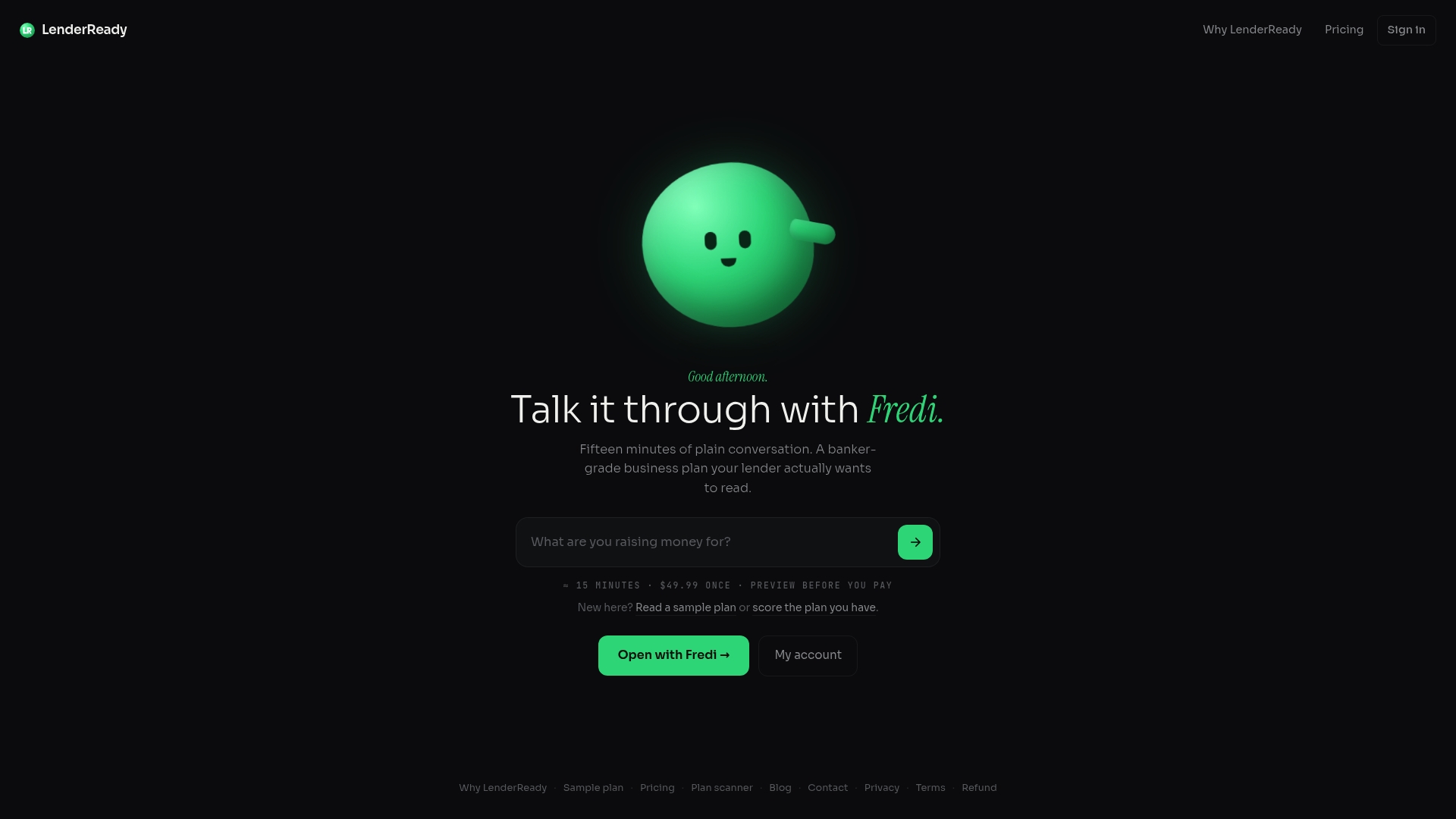
The free Business Plan Check is a good first step if you already have a draft and want to know where it falls short before you submit it. If you are starting from scratch, the full AI-generated plan gives you a submission-ready document without the back-and-forth of hiring a consultant or spending a weekend in a spreadsheet. For operating businesses, the Financial Statement Scan adds a real readiness finding before you decide whether to build the full Application File.
Pricing is a one-time fee without an ongoing subscription requirement. Visit LenderReady to run the free scan or purchase your plan.
Sources and further reading
- 10 Best AI business plan generators (tested and compared). Monday.com’s roundup covering execution-focused platforms, integrations, and financial modelling criteria.
- 7 powerful AI business plan generators. Pipedrive’s buyer guide with comparative notes on forecasting depth, accounting integrations, and selection criteria including editable forecast exports and DSCR checks.
- How to use AI in business planning. Investopedia’s overview of how generative AI improves forecasting accuracy and reduces manual planning work.
- 10 best business plan software. Forbes Advisor’s list covering both established planning software and newer AI-native generators.
- LenderReady. The landing page with full details on the conversational Q&A process, financial modelling features, and source-backed Application File.
Pro Tip: Before committing to any tool, ask the vendor to walk you through a sample DSCR calculation and show you the editable Excel export. If they cannot do both in under five minutes, the tool is not ready for a Canadian lender submission.
See where your financing file stands
Fifteen questions, four minutes, no documents and no email. You get a readiness stage, the gaps a lender would raise, and the document list for your request.
Check my readiness, freeLenderReady is an educational service, not a lender, broker, or financial advisor. Lending criteria vary by institution and change over time; treat this as a starting point, not a guarantee.