Best financial projection software for Canadian founders

For Canadian founders preparing a bank or BDC submission, LenderReady is the strongest business-plan-focused financial projection tool available. It automates the outputs lenders actually check: DSCR, sensitivity scenarios, and a documented assumptions export, all within a 15-minute conversational workflow. If you are heading toward a Canada Small Business Financing Program (CSBFP) application or a BDC loan, start with LenderReady’s free plan readiness scan before you submit anything.
Table of Contents
- What do Canadian lenders and investors actually check in your financials?
- How do you build credible, lender-ready bottom-up projections?
- Which features actually matter in financial projection software?
- What red flags do lenders see most often in Canadian business plans?
- How does LenderReady address these lender-readiness needs?
- How long does it take, and what does it cost?
- How to select and implement financial projection software for your Canadian business
- Guidance and training for Canadian financial regulations and reporting standards
- Key takeaways
- What Canadian founders often miss about lender conversations
- LenderReady gets you to investor-ready financials faster
- Useful sources and further reading
What do Canadian lenders and investors actually check in your financials?
The short answer: they look for evidence you understand your own numbers, not just that you have them.
Canadian lenders and investors focus on a specific set of checks before they read anything else:
- Debt Service Coverage Ratio (DSCR). BDC guidance commonly expects a DSCR of 1.1x–1.2x for small business lending. Files with a DSCR below 1.0x are flagged as high risk immediately.
- Three linked statements. Income statement, cash flow, and balance sheet must reconcile to each other. A cash flow that does not tie to the P&L is an instant credibility problem.
- 3–5 year horizon. A complete bank-grade financial pack includes at least three years of projections, with Year 1 broken out month by month.
- Scenario and sensitivity analysis. Lenders want to see a downside case, not just your best-case forecast.
- Documented assumptions. Every key input needs a source: a contract, a pilot metric, or an industry benchmark.
- Use-of-funds table. For CSBFP and BDC applications, line-itemised use of funds (equipment, leasehold, working capital, contingency) is expected, not bucket totals.
On DSCR specifically: a ratio of 1.25x means the business generates $1.25 in operating cash for every $1.00 of debt service. Anything below 1.1x will prompt questions; below 1.0x, most lenders stop reading.
Bottom-up, driver-based revenue modelling matters because it demonstrates management control. Canadian CPAs who prepare bank submissions consistently flag top-down forecasts (“we will capture 2% of a $500M market”) as a red flag. A model built from customer acquisition rate, average order value, and purchase frequency is far more credible than a market-share guess.

How do you build credible, lender-ready bottom-up projections?
The single most important rule: build revenue from the bottom up, then reconcile every dollar to your cash flow statement. Investor-ready forecasts are judged on timing as much as totals.
- Define your revenue drivers. Start with customer acquisition rate, unit price, purchase frequency, and retention. These four inputs generate your revenue line.
- Build unit economics. Calculate gross margin per unit or per customer before you project any totals.
- Map payment timing. Model receivables lag (when customers actually pay) and payables terms (when you pay suppliers). Cash-flow timing is often the issue that sinks otherwise plausible plans.
- Link statements. Connect your P&L to your cash flow statement and balance sheet so every number reconciles.
- Add scenarios. Build a base case, an upside, and a downside. Your downside should reflect a significant revenue reduction from base.
Documentation lenders read first:
- Assumptions page mapping each key input to its source
- Use-of-funds table broken into specific line items
- DSCR calculation shown explicitly, not buried
Pro Tip: Model your downside case at 20–30% below base revenue and recalculate DSCR. If your downside DSCR falls below 1.0x, address it before submission. Lenders will find it, and you want to control that conversation.
Which features actually matter in financial projection software?

The single most important feature cluster is a scenario engine combined with assumptions documentation and an exportable audit trail. Everything else is secondary.
Here is how the features map to real lender needs:
- DSCR calculation (mandatory). The software must calculate and display DSCR automatically. If you have to compute it manually in a spreadsheet, you will make errors under pressure.
- Scenario and sensitivity tools (mandatory). Investor-grade models must include scenario analysis. A single-case plan signals inexperience.
- Assumptions export (mandatory). A PDF or Excel export of your assumptions page is what lenders use during due diligence. Without it, your numbers look like guesses.
- Three linked statements with CAD handling (mandatory). Canadian currency, GST/HST timing, and CRA-aligned tax treatment matter for any submission to a Canadian institution.
- PDF and Excel export (mandatory). Most lenders want a clean PDF for review and an Excel file for their own analysis.
- Versioning and audit trail (strongly recommended). When a lender asks “what changed between version 1 and version 2?”, an audit trail answers that question without a scramble.
- Canadian templates for BDC/CSBFP (strongly recommended). Templates pre-structured for Canadian program requirements save hours of reformatting.
- Integration with accounting software (nice-to-have). Pulling actuals from QuickBooks or Xero reduces manual entry errors, especially for businesses with 12+ months of history.
- Optional human or banker review (nice-to-have for most, mandatory for complex deals). A qualified reviewer catches modelling errors a founder cannot see.
A useful benchmark: BDC’s own guidance on financial projections emphasises that projections must show how you will repay loans, what you intend to do with the money, and how you will grow. Software that does not produce all three outputs is incomplete for a funding submission.
What red flags do lenders see most often in Canadian business plans?
“The first thing I check is the use-of-funds table and the cash flow. If the cash flow does not reconcile to the P&L, or the use-of-funds is vague, I know the founder has not modelled the business. They have modelled a wish.” Perspective shared by Canadian bank underwriters, as summarised in Custom CPA’s bank loan guidance
The most common red flags, and how to fix them quickly:
- Top-down revenue forecast. Quick check: Does your revenue line start from a market-share percentage? Fix: Rebuild from customer acquisition rate and average transaction value.
- Missing cash-flow timing. Quick check: Does your cash flow assume customers pay the same month you invoice? Fix: Add a receivables lag column and model supplier payment terms separately.
- Single-scenario plan. Quick check: Is there only one revenue forecast? Fix: Add a downside case at 20–30% below base and show the DSCR impact.
- Vague use-of-funds. Quick check: Does your use-of-funds say “equipment and working capital”? Fix: Break it into specific line items with dollar amounts in CAD.
- Missing assumptions documentation. Quick check: Can a stranger read your plan and understand where every number came from? Fix: Add an assumptions page with sources for each key input.
How does LenderReady address these lender-readiness needs?
LenderReady’s plan builder produces a lender-grade forecast quickly because it automates driver-based inputs, DSCR calculation, sensitivity analysis, and assumptions export through a conversational Q&A. You answer questions about your business; it builds the model.
| Lender need | LenderReady capability |
|---|---|
| DSCR calculation | Automated, shown explicitly in the output |
| Scenario analysis | Base, upside, and downside cases generated automatically |
| Assumptions export | Exportable PDF with documented inputs |
| Three linked statements | P&L, cash flow, and balance sheet reconciled |
| Canadian currency and tax handling | CAD-native, with Canadian tax timing |
| BDC/CSBFP-aligned templates | Pre-structured for Canadian program submissions |
| Plan readiness scan | Free tool to check your plan against lender criteria |
| Source-backed Application File | Optional paid review by a qualified reviewer |
Time to first draft: the conversational workflow produces an initial financial pack in approximately 15 minutes. Scenario refinement and human review add time, but the starting point is a complete, exportable document rather than a blank spreadsheet.
For a deeper look at building revenue schedules lenders accept, LenderReady’s blog covers the driver logic in detail.
How long does it take, and what does it cost?
Typical timelines:
- 15 minutes: First draft with AI (LenderReady’s conversational workflow)
- 1–3 hours: Scenario refinement, sensitivity tuning, and assumptions review
- 1–3 days: If you need to gather and verify historical financials
Pricing shapes to expect:
- AI-generated business plan software: typically a one-time fee, significantly less than hiring a consultant or CPA for a full financial model
- Application File: an optional one-time product for source-backed operating evidence and deterministic readiness findings
- DIY spreadsheet approach: free in software cost, but often 20–40 hours of founder time and a higher risk of modelling errors
To accelerate the process:
- Gather 12 months of historical financials (or your best estimates for a startup) before you begin
- Have a clear use-of-funds figure in mind, broken into specific categories
- Know your key revenue drivers: how many customers, at what price, buying how often
How to select and implement financial projection software for your Canadian business
A structured selection process saves you from switching tools mid-application, which is expensive in time and confidence.
- Confirm Canadian compliance first. The software must handle CAD, Canadian tax timing (GST/HST), and produce outputs aligned with BDC or CSBFP expectations. A tool built for US founders will require significant manual adjustment.
- Check integration with your accounting software. If you use QuickBooks Online or Xero, a tool that pulls actuals directly reduces manual entry and errors. Cash-flow optimisation starts with accurate data inputs.
Guidance and training for Canadian financial regulations and reporting standards
Canadian founders face a specific set of requirements that generic financial software often ignores: GST/HST remittance timing, CRA-aligned depreciation schedules, and the documentation standards expected by BDC and CSBFP underwriters.
Good service in this context means more than a chat widget. It means guidance that reflects how Canadian lenders actually evaluate a business plan, including the DSCR thresholds, the use-of-funds detail, and the scenario analysis that federal programs expect.
LenderReady provides Canadian-specific templates updated for 2026, educational guides covering BDC and CSBFP requirements, and a source-backed Application File for operating businesses. The Business Plan Check is free and takes minutes, giving you a gap analysis against lender criteria rather than a generic checklist.
For founders with irregular or project-based revenue, LenderReady’s guides on seasonal revenue modelling address the specific cash-flow smoothing techniques that lenders accept.
Key takeaways
Bottom-up, driver-based projections with documented assumptions and a DSCR calculation are the minimum standard for any Canadian lender or investor submission in 2026.
| Point | Details |
|---|---|
| DSCR is the first number lenders check | Target 1.1x–1.2x; model your downside case to confirm it holds. |
| Bottom-up modelling builds credibility | Build revenue from customer acquisition, price, and frequency, not market-share estimates. |
| Cash-flow timing is often the fatal gap | Model receivables lag and supplier terms explicitly, not as same-month assumptions. |
| Assumptions documentation is mandatory | Export a PDF assumptions page with sources for every key input before submitting. |
| LenderReady produces a lender-grade pack in 15 minutes | LenderReady automates DSCR, scenarios, and assumptions export, with Canadian templates and a source-backed Application File. |
What Canadian founders often miss about lender conversations
Most founders I speak with treat the financial projections as the last thing they build, something to fill in after the narrative is done. That is backwards. The projections are the argument. A lender reading your plan is not looking for a story; they are looking for evidence that you have modelled the downside and still have enough cash flow to service the debt.
The founders who get funded are not always the ones with the best businesses. They are the ones who walked in with a DSCR calculation, a downside scenario, and a clean assumptions page. That preparation signals something a great narrative cannot: that you understand your own numbers well enough to defend them under pressure.
If you are not sure whether your current plan meets that standard, the free readiness scan at LenderReady is the fastest way to find out. It takes minutes and tells you exactly where the gaps are before a lender finds them first.
LenderReady gets you to investor-ready financials faster
A blank spreadsheet and a funding deadline is a stressful combination. LenderReady removes the blank-page problem entirely. In 15 minutes of conversational Q&A, it produces a complete financial pack: three linked statements in CAD, DSCR calculated, scenarios built, and an assumptions PDF ready to export.
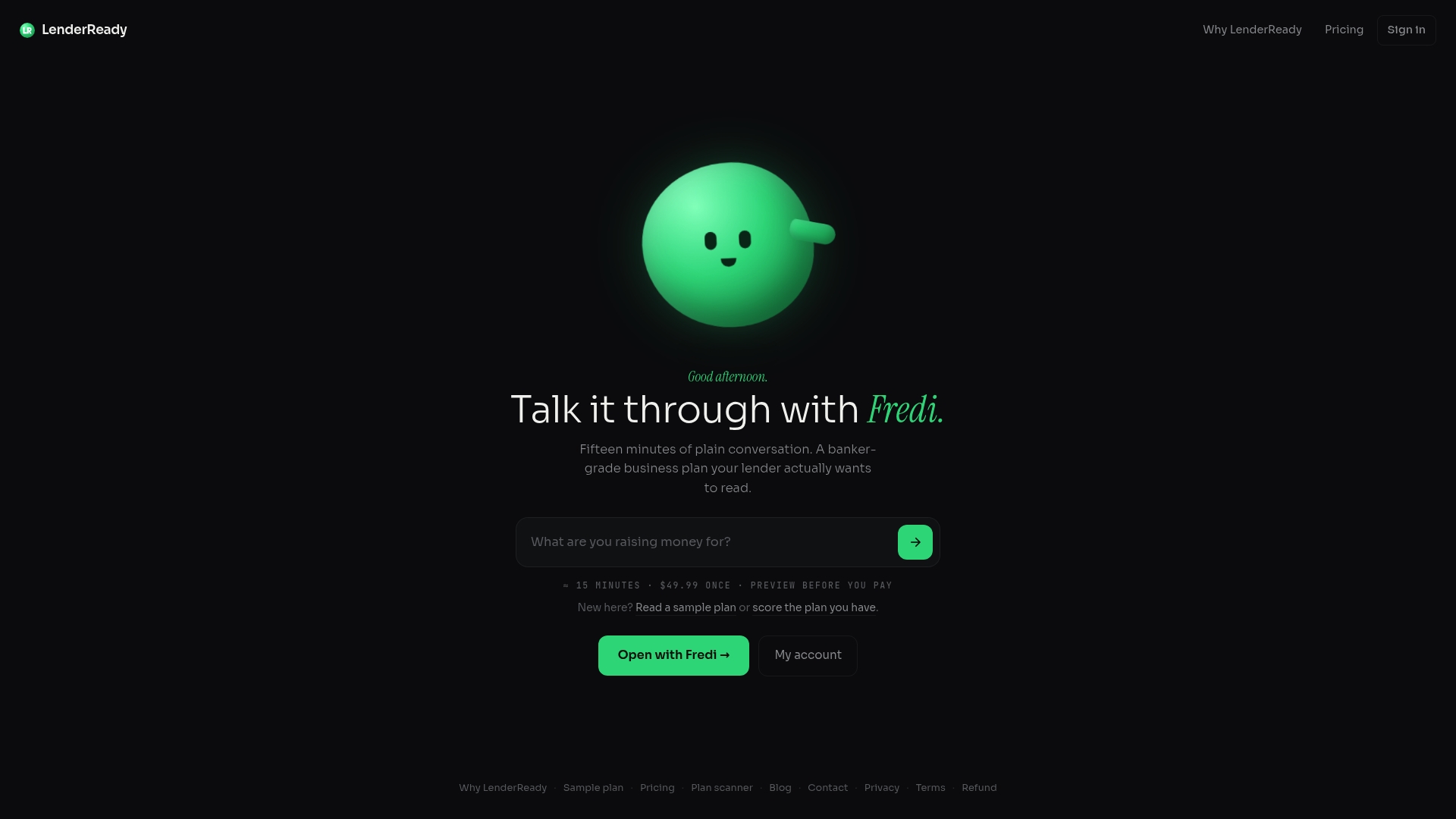
For founders preparing a BDC loan, a CSBFP application, or an investor pitch, the outputs are structured to match what Canadian underwriters expect, not a generic template that needs hours of reformatting. The Business Plan Check is free and takes minutes. The full AI-generated plan is a one-time fee, and operating businesses can add the Application File when they need source-backed readiness findings before submission.
See how LenderReady compares to building your plan manually and decide whether the 15-minute path fits your timeline.
Useful sources and further reading
- Canada Small Business Financing Program (ISED), the official program page; confirms eligibility rules, lender process, and documentation requirements.
- Business Plan Guide for Canadian SMEs: Enno Consulting, practical DSCR guidance and CSBFP documentation expectations from a Canadian advisory firm.
- Investor-ready projections: EIM Services, technical guidance on driver logic, cash-flow reconciliation, and scenario analysis for Canadian founders.
- When you need investor-ready forecast modelling: Jedidiah CPA: CPA perspective on what separates investor-grade models from internal budgets.
- Bank loan business plans Canada: Custom CPA: Saskatchewan-based CPA guidance on what Canadian banks look for in a loan submission.
- NGen Investor Guide (PDF), checklist for a complete bank-grade financial pack including use-of-funds and sensitivity analysis.
- How to make financial projections for a new business: BDC. BDC’s own six-step framework for building projections that satisfy lenders.
- Business plan financials: your 2026 guide for Canada: LenderReady: Canadian-specific templates, DSCR guidance, and 2026 updates for business plan financials.
This article provides general information for educational purposes. It is not financial, legal, or accounting advice. Confirm current program requirements and thresholds with BDC, your financial institution, or a qualified Canadian CPA before submitting a funding application.
See where your financing file stands
Fifteen questions, four minutes, no documents and no email. You get a readiness stage, the gaps a lender would raise, and the document list for your request.
Check my readiness, freeLenderReady is an educational service, not a lender, broker, or financial advisor. Lending criteria vary by institution and change over time; treat this as a starting point, not a guarantee.