Business Plan for Funding: A Canadian Entrepreneur's Guide

A business plan for funding is a formal document that lays out your business strategy, market opportunity, and financial projections specifically to convince a lender or investor to commit capital. In Canada, that means tailoring every section to what banks, the Business Development Bank of Canada, government grant programs, and private investors actually look for. A generic template won’t cut it. The plan needs to speak the language of whoever controls the money you’re after.
Every credible funding plan covers these core elements:
- Executive summary: A concise snapshot of your business and the funding request, written last but read first
- Company overview: Legal structure, location, founding story, and mission
- Market analysis: Target customers, market size, and competitive positioning
- Marketing and sales plan: How you’ll acquire and retain customers
- Operations plan: Day-to-day processes, suppliers, staffing, and facilities
- Financial plan: Revenue projections, expense forecasts, cash flow statements, and a clear funding request
- Funding request: Exact amount needed, intended use, and preferred financing terms
The funding request section is where most Canadian entrepreneurs underdeliver. Lenders want to know not just how much you need, but precisely what you’ll spend it on, whether that’s equipment, working capital, or hiring, and what your repayment or return plan looks like.
What goes into a business plan for funding in Canada?
Traditional business plans of 15–20 pages are nearly always required for institutional financing. Each section carries weight, and skipping or thinning out any one of them raises red flags.
- Executive summary: Write this last. Investors often read only this section before deciding whether to continue, so it needs to distill your entire case into one or two pages.
- Business description: Legal name, structure, location, founding date, and what problem you solve. Keep it factual and specific.
- Market analysis: Size your market with real data. Identify your target customer, your competitors, and your competitive edge. This section is often the longest and the most scrutinized.
- Marketing and sales plan: How you’ll reach customers, your pricing strategy, and your sales process.
- Operations plan: Suppliers, production or service delivery, technology, and staffing. Lenders want to know the business can actually run.
- Financial plan: Revenue projections, expense forecasts, and cash flow statements. For startups without historical data, realistic projections grounded in market research are what bankers assess most carefully.
- Funding request: State the exact amount, the intended use of funds, and whether you’re seeking debt or equity. Include your repayment plan or exit strategy.
One detail that separates strong plans from weak ones: personal capital contribution. Showing that you’ve put your own money in signals commitment and reduces perceived risk for lenders. Asking for 100% outside funding without any personal stake is a common reason applications get declined.
Addressing risk openly also matters more than most entrepreneurs expect. Lenders know every business has risks. A plan that identifies them and explains mitigation strategies reads as professional. One that ignores them reads as naive.
Canadian government and non-profit resources for business planning
Canada has a strong network of publicly funded resources that can reduce the cost and complexity of building a funding plan.
- Futurpreneur Canada: Start-up loans up to a substantial amount, paired with mentorship for entrepreneurs up to age 39, with dedicated programs for Black and Indigenous founders.
- Canada.ca business planning resources: The federal government’s planning hub offers guides, checklists, and links to provincial programs.
- FedDev Ontario: Provides sample business plans and templates tailored for Canadian businesses, particularly in southern Ontario.
- Business Development Bank of Canada (BDC): Offers financing, advisory services, and planning tools specifically for Canadian small businesses.
- Community Futures offices: Operate across rural Canada, providing business planning help, loans, and mentorship at the local level.
- Women’s Enterprise organizations: Provincially based groups offering planning help, financing, and mentorship for women entrepreneurs.
Most of these resources are free or low-cost. Using them before hiring a paid consultant can sharpen your plan and reduce the scope of work you need to outsource.
What types of funding are available to Canadian entrepreneurs?
The funding source shapes the plan. Each type has different requirements and expectations.
Debt financing includes bank loans, credit union loans, and the Canada Small Business Financing (CSBF) program, which lets the federal government guarantee a portion of your loan to reduce lender risk. These require detailed financial projections and collateral.
Equity financing covers angel investors and venture capital. Investors take an ownership stake in exchange for capital. They care more about growth potential and your team than about collateral.
Government grants and contributions come from federal and provincial programs. Unlike loans, grants don’t need to be repaid, but the application process is competitive and documentation-heavy. A grant proposal business plan is typically narrower and more project-focused than a full business plan.
Non-profit and community lending through organizations like Futurpreneur or Community Futures fills gaps that traditional banks won’t touch, especially for early-stage businesses or underserved founders.
Self-funding and friends-and-family capital is often the first round. Documenting this clearly in your plan shows lenders you have skin in the game.
Practical templates and bundles for Canadian businesses
Free templates are a good starting point, but the best ones are built for Canadian context.
The SCORE startup template is widely used and covers all standard sections with fillable worksheets. FedDev Ontario’s sample plans show what funded Canadian businesses actually submitted. The Canada.ca planning section links to provincial resources that reflect local regulatory and market conditions.
For entrepreneurs who want more than a blank template, Business Plan Experts and The Biz Plans both offer custom-built plans that include financial modeling. These aren’t fill-in-the-blank documents; they’re built from your actual numbers and market data.
How long does it take to go from a business plan to secured funding?
The plan itself, if written professionally, typically takes two to four weeks to complete. Government grant applications add another four to twelve weeks for review. Bank loan decisions usually come within two to six weeks of a complete application. Venture capital timelines are the least predictable, often running three to nine months from first contact to a signed term sheet.
The SBA recommends treating your business plan as a living document, updating it annually or after any major business pivot. A plan with dated projections signals to lenders that the founder isn’t actively managing the business.
How AI is changing business plan creation for Canadian entrepreneurs
Conversational AI tools have cut the time to produce a first draft from weeks to minutes. LenderReady’s platform generates a tailored business plan through a guided conversational Q&A in about 15 minutes. The output includes financial modeling with debt service coverage ratio (DSCR) calculations, sensitivity analysis, and documented assumptions, the same rigor a bank credit officer expects to see.
Key features that matter for funding applications:
- Instant feedback and unlimited revisions: Refine the plan before submitting, not after a rejection
- Free plan readiness scan: Identifies gaps before a lender does
- Source-backed Application File: your operating statements, ratios, readiness findings, and next actions stay together for review before you submit
For entrepreneurs who need a lender-ready document quickly and at a fraction of the cost of a consultant, this approach closes a real gap in the market.
LenderReady offers a faster path to a lender-ready plan
The services compared above are strong options for entrepreneurs who want a human consultant to build their plan. But if you need a lender-ready business plan without a four-week wait or a $3,000 invoice, LenderReady is worth a serious look.
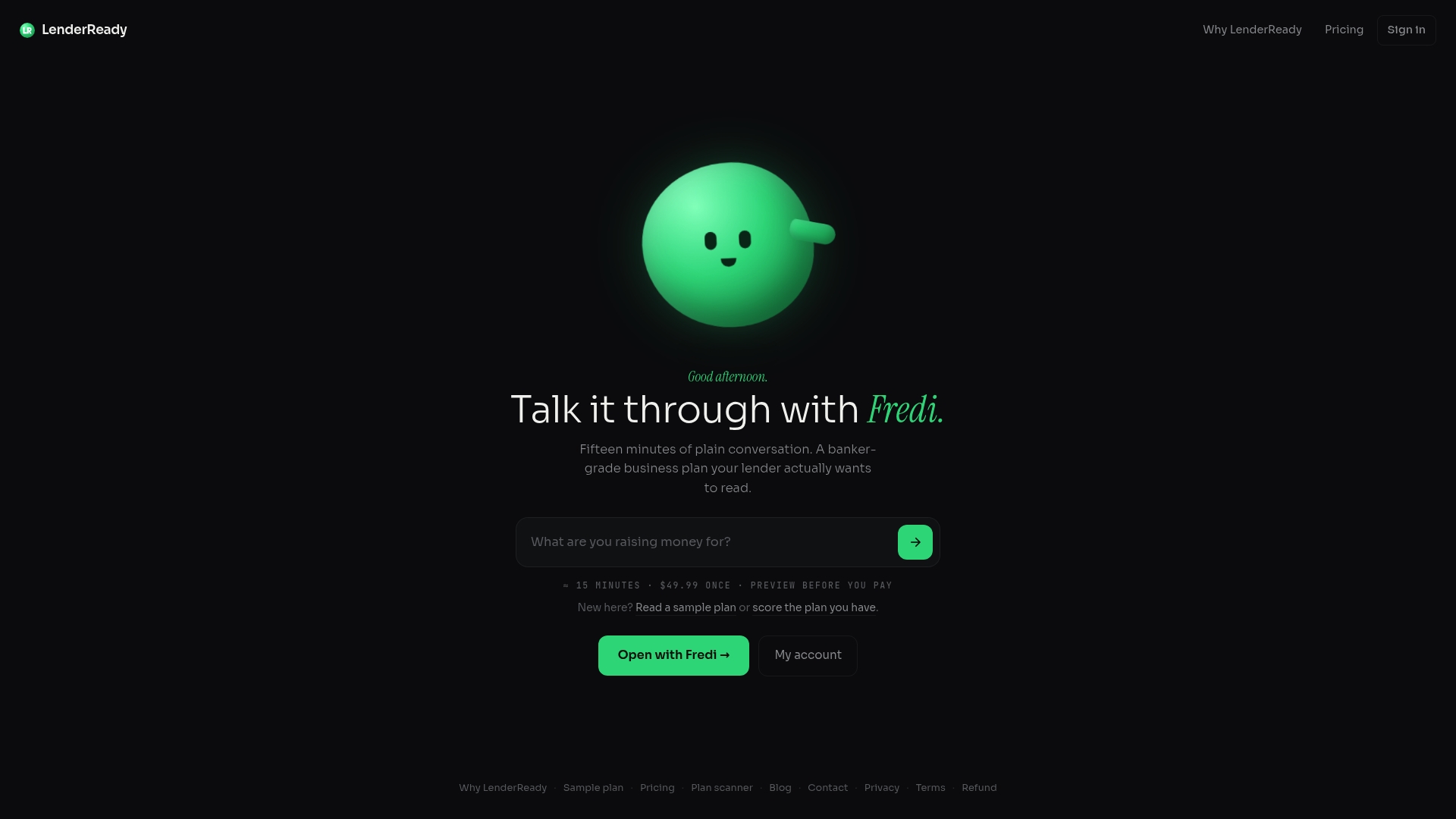
LenderReady’s plan builder walks you through your business in a conversational Q&A and produces a complete plan, including financial projections, DSCR analysis, and a funding request section, in about 15 minutes. You can revise it as many times as you need, run the free Business Plan Check to catch weaknesses, and scan one operating statement when you want readiness figures tied to their source. It’s a one-time fee, no ongoing subscription, and no waiting on a consultant’s schedule. For Canadian entrepreneurs who are ready to move fast, start your plan at LenderReady.ca.
Key Takeaways
A strong business plan for funding in Canada requires the right structure, the right numbers, and alignment with your specific funding source’s expectations.
| Point | Details |
|---|---|
| Tailor the plan to the funder | Banks, grant programs, and investors each require different emphasis; one generic plan rarely satisfies all three. |
| Personal capital contribution matters | Showing your own investment reduces perceived lender risk and is a common factor in approved applications. |
| Address risks openly | Plans that identify risks and mitigation strategies read as professional; those that ignore risks raise red flags. |
| Professional services vary by specialization | Futurpreneur suits young and diverse founders; Business Plan Experts covers complex multi-source funding; The Biz Plans leads on CPA-grade financial modeling. |
| LenderReady speeds up the process | LenderReady’s AI generates a lender-ready plan with financial modeling in about 15 minutes, at a fraction of consultant costs. |
See where your financing file stands
Fifteen questions, four minutes, no documents and no email. You get a readiness stage, the gaps a lender would raise, and the document list for your request.
Check my readiness, freeLenderReady is an educational service, not a lender, broker, or financial advisor. Lending criteria vary by institution and change over time; treat this as a starting point, not a guarantee.