CapEx vs OpEx explained for Canadian business owners

Capital expenditures (CapEx) are long-lived investments you capitalise on the balance sheet and recover over time through the Canada Revenue Agency’s Capital Cost Allowance (CCA) system. Operating expenses (OpEx) are day-to-day costs you deduct in full in the year you incur them. That single distinction shapes your tax bill, your EBITDA, your cash flow, and what a lender sees when they open your financials.
Three quick examples to orient you:
- CapEx: Purchasing a $120,000 CNC machine for your shop floor. It goes on the balance sheet and is depreciated over its useful life using the applicable CCA class.
- OpEx: Paying rent regularly. It hits the income statement immediately and is fully deductible this year.
- Borderline: A laptop with a value near typical capitalisation thresholds. Depending on your capitalisation policy and CRA guidance, it may be CapEx (capitalised and claimed via CCA) or expensed directly if your threshold treats it as immaterial.
Key takeaways
The single most important rule: if an asset provides economic benefit beyond one year, capitalise it and recover the cost through CCA; if it is consumed this year, expense it immediately.
| Point | Details |
|---|---|
| Useful life test | Any asset with a useful life beyond 12 months is generally CapEx; shorter-lived costs are OpEx. |
| Canadian tax treatment | CapEx is recovered via CCA classes and rates; OpEx is fully deductible in the year incurred. |
| EBITDA and cash flow | Capitalising costs raises EBITDA but reduces free cash flow; lenders look at both figures. |
| Documentation matters | Keep invoices, capitalisation policy, and CCA schedules to stand up to audits and lender reviews. |
| Lender expectations | Consistent capitalisation policy and realistic depreciation assumptions are what lenders trust. |
Table of Contents
- What is the difference between CapEx and OpEx?
- What counts as capital expenditure?
- What counts as an operating expense?
- How do CapEx and OpEx appear in your financial statements?
- How does Canada Revenue Agency treat CapEx and OpEx?
- How do you classify borderline items?
- When should you choose CapEx over OpEx?
- Practical scenarios: how classification plays out
- What lenders and investors look for in your CapEx vs OpEx choices
- How to budget and forecast CapEx and OpEx
- A note from the LenderReady team
- Sources
What is the difference between CapEx and OpEx?
The table below captures the core distinctions finance teams and lenders reach for first.
| Dimension | CapEx | OpEx |
|---|---|---|
| Definition | Acquisition or improvement of a long-lived asset | Recurring cost consumed within the accounting period |
| Financial statement | Balance sheet (asset) | Income statement (expense) |
| Tax timing (Canada) | Recovered over time via CCA | Deductible in the year incurred |
| Effect on EBITDA | Increases EBITDA (cost not on P&L initially) | Reduces EBITDA immediately |
| Cash flow classification | Investing activities | Operating activities |
| Typical examples | Buildings, machinery, fleet, software development | Salaries, rent, utilities, SaaS subscriptions |
Three differences that matter most for decision-makers:
- Tax timing. OpEx gives you an immediate deduction; CapEx spreads relief across years through CCA, which affects your near-term tax position significantly.
- EBITDA impact. Capitalising costs moves them off the income statement initially, inflating EBITDA relative to a business that expenses the same spend as OpEx. Investors normalise this during due diligence.
- Approval and budgeting process. CapEx typically requires formal multi-year approval and board sign-off; OpEx flows through the operating budget with far less friction.
What counts as capital expenditure?
Capital expenditures are costs to acquire or improve assets with useful lives beyond one year. The accounting logic is straightforward: because the asset generates value over multiple periods, you match the cost to those periods through depreciation (tangible assets) or amortisation (intangible assets).
Common CapEx categories include:
- Buildings and real property: Purchase price plus closing costs and any structural improvements.
- Machinery and production equipment: Factory lines, HVAC systems, industrial tools.
- Fleet vehicles: Trucks, vans, and company cars purchased outright.
- Major software development: Costs incurred during the application-development stage of an internal build, not the planning or post-implementation stages.
- Leasehold improvements: Renovations to a leased space that extend beyond the lease term or add lasting value.
One important exception: land is never depreciated, because it does not wear out or become obsolete.
Accounting mechanics in practice: A manufacturer buys a $500,000 production line. That $500,000 never touches the income statement on day one. Instead, it sits on the balance sheet as a capital asset and is depreciated over its useful life. EBITDA looks strong in year one, but free cash flow reflects the full $500,000 outflow in the investing section of the cash flow statement. Lenders see both numbers.
What counts as an operating expense?
OpEx covers the costs your business consumes to keep running day to day. These costs are recognised on the income statement in the period they are incurred, reducing net income and your taxable income right away.
Typical OpEx items:
- Salaries, wages, and employee benefits
- Rent and property lease payments
- Utilities (electricity, gas, internet)
- Routine software subscriptions (monthly CRM, accounting software, cloud storage)
- Professional fees (legal, accounting, consulting)
- Repairs and maintenance that restore an asset to its original condition without extending its life
The contrast between a subscription and a perpetual licence illustrates the difference cleanly. A $200/month project-management subscription is OpEx: you expense $2,400 this year and deduct it fully. A $25,000 perpetual software licence with a multi-year useful life is CapEx: you capitalise it and claim CCA over time. Typical CapEx examples include buildings, machinery and long-term software; OpEx examples include salaries, rent and routine subscriptions.
The practical effect on your income statement is immediate. Every dollar of OpEx reduces your pre-tax profit this year, which lowers your tax bill now. That is why some owners are tempted to push borderline items into OpEx, a temptation worth resisting carefully.

How do CapEx and OpEx appear in your financial statements?
Knowing where each cost lands helps you read your own financials and anticipate what a lender or investor will scrutinise.
Balance sheet and cash flow statement (CapEx): CapEx appears as a non-current asset on the balance sheet. On the cash flow statement, it shows up under investing activities as a cash outflow. Each year, a depreciation charge flows through the income statement, reducing the asset’s carrying value.
Income statement and cash flow statement (OpEx): OpEx hits the income statement directly, reducing gross profit or operating income in the current period. On the cash flow statement, it is part of operating activities.
Key metrics affected:
- EBITDA: Capitalising costs keeps them off the P&L, so EBITDA is higher than if the same spend were expensed. This is not a trick; it is accounting convention, but it means you need to read EBITDA alongside free cash flow.
- Operating margin: Heavy OpEx compresses operating margin immediately; CapEx spreads the cost, so margin looks better near-term.
- Free cash flow (FCF): FCF deducts capital expenditures from operating cash flow. A CapEx-heavy business can show strong EBITDA and thin FCF simultaneously.
- Asset turnover and leverage ratios: Large CapEx increases total assets, which affects asset turnover and debt-to-asset ratios that lenders monitor in covenants.
Lenders closely review capitalisation policies and the assumptions behind depreciation and replacement cycles when underwriting loans for asset-heavy businesses. If your depreciation schedule looks aggressive or your replacement cycle is unrealistic, expect questions.
How does Canada Revenue Agency treat CapEx and OpEx?
In Canada, the distinction between capital and operating expenditure is not just an accounting choice; it is a tax matter governed by the Income Tax Act and administered by the Canada Revenue Agency (CRA).
OpEx: Generally deductible in the year incurred. Salaries, rent, and routine maintenance reduce your taxable income dollar for dollar in the current tax year.
CapEx and the CCA system: Capital expenditures cannot be fully deducted in the year of purchase. Instead, you add the cost to the appropriate CCA class and claim a prescribed percentage each year. Common classes include:
- Class 1 (4%): Most buildings acquired after 1987.
- Class 8 (20%): Miscellaneous tangible capital property, including office furniture and equipment.
- Class 10 (30%): Motor vehicles and some computer hardware.
- Class 50 (55%): General-purpose computer equipment and systems.
- Class 14.1 (5%): Eligible capital property such as goodwill and customer lists.
CCA uses a declining-balance method for most classes, meaning you claim a percentage of the remaining undepreciated capital cost (UCC) each year, not the original purchase price. The half-year rule also applies in the year of acquisition for most classes, limiting your first-year claim to half the normal rate.
CRA reminder: CCA classes and rates change, and some assets qualify for accelerated investment incentive provisions (AIIP) that allow larger first-year deductions. Always confirm the correct class and current rate with the CRA’s official guidance or a qualified tax professional before filing.
Pro Tip: Keep a separate CCA schedule for each asset class in your accounting records. When a lender or CRA auditor asks for your depreciation policy, a clean, class-by-class schedule with purchase dates and UCC balances is the fastest way to demonstrate you have classified assets correctly.
How do you classify borderline items?
Grey-area items are where most classification errors happen, and where audits and lender due diligence get uncomfortable. Misclassifying large purchases to obtain immediate tax relief is a common risk that can attract scrutiny from tax authorities and affect lender or investor confidence.
Practical rules of thumb:
- Useful life test: Does the item provide economic benefit beyond 12 months? If yes, it is likely CapEx.
- Improvement vs. maintenance: Does the work extend the asset’s life or increase its capacity? CapEx. Does it merely restore the asset to working condition? OpEx.
- Materiality threshold: Most businesses set a capitalisation threshold (often $1,000–$2,500 for small businesses, higher for larger ones). Items below the threshold are expensed regardless of useful life.
- Software: For IT spending, classification depends on usage and development stage: subscription services are usually OpEx; internal development from the application-development stage may be capitalised as CapEx.
Common borderline items classified:
- Laptops and computers: Usually CapEx above your capitalisation threshold (CRA Class 50 at 55% CCA). Below threshold, expense immediately.
- Software subscriptions (SaaS/cloud): OpEx. Monthly or annual fees with no ownership transfer are operating costs.
- Perpetual software licences: CapEx if the useful life exceeds one year.
- Repairs vs. improvements: Replacing a broken HVAC compressor is OpEx (maintenance). Upgrading to a higher-capacity system is CapEx (improvement).
- Employee salaries: Always OpEx, even for staff working on a capital project. The exception is direct labour capitalised as part of a self-constructed asset under specific accounting standards.
Mini decision flow:
- Does the item have a useful life beyond 12 months? If no, expense it.
- Does it meet your capitalisation threshold? If no, expense it.
- Does it improve an existing asset or create a new one? If yes, capitalise.
- Is it a subscription or service with no ownership transfer? If yes, expense it.
- If still uncertain, consult your CCA class list or a tax adviser before filing.
Pro Tip: For every capitalised item, retain the original invoice, purchase order, and a brief written note explaining why it meets your capitalisation policy. That file is your first line of defence in a CRA audit or lender due diligence review. Document retention, including board approvals and capitalisation policies, is the practical defence in a tax audit or lender diligence process.
When should you choose CapEx over OpEx?
The right choice depends on your cash position, tax strategy, and how a lender will read the decision. Neither is universally better.
Decision checklist:
- Cash availability: Can you fund the purchase without straining working capital? If not, OpEx alternatives (subscriptions, leases) preserve liquidity.
- Tax position: Do you have taxable income to shelter now? OpEx gives immediate relief. If you expect higher income in future years, spreading deductions via CCA may be more valuable.
- Useful life and obsolescence: Technology that becomes obsolete in two to three years is a poor CapEx candidate. Opt for subscriptions or short-term leases instead.
- Control and customisation: Need to modify the asset significantly? Ownership (CapEx) gives you that freedom; a subscription or operating lease usually does not.
- Regulatory or contractual requirements: Some industries or lender covenants require ownership of certain assets. Check before choosing OpEx alternatives.
Pros and cons at a glance:
- CapEx pros: Asset ownership, potential appreciation, long-term cost savings, stronger collateral for lenders.
- CapEx cons: Large upfront cash outlay, slower tax relief, formal approval process, obsolescence risk.
- OpEx pros: Immediate deduction, lower upfront cost, flexibility to scale or cancel, faster procurement.
- OpEx cons: No asset ownership, potentially higher total lifetime cost, no collateral value.
Financing options that shift cash impact: Choosing OpEx (for example SaaS or cloud services) increases flexibility and reduces up-front cash needs, while CapEx often requires larger upfront investment and formal approval processes. For physical assets, an equipment financing arrangement (lease vs. loan vs. cash) changes your cash flow profile without necessarily changing the accounting classification. An operating lease keeps the asset off your balance sheet; a finance (capital) lease brings it on. Know which you are signing before you commit.
Red flags requiring formal review: Any single purchase above your materialit threshold, any item that could trigger a lender covenant, or any classification that differs from industry norms warrants a conversation with your accountant or tax adviser before you file.
Practical scenarios: how classification plays out
Scenario 1: On-premise server vs. cloud storage
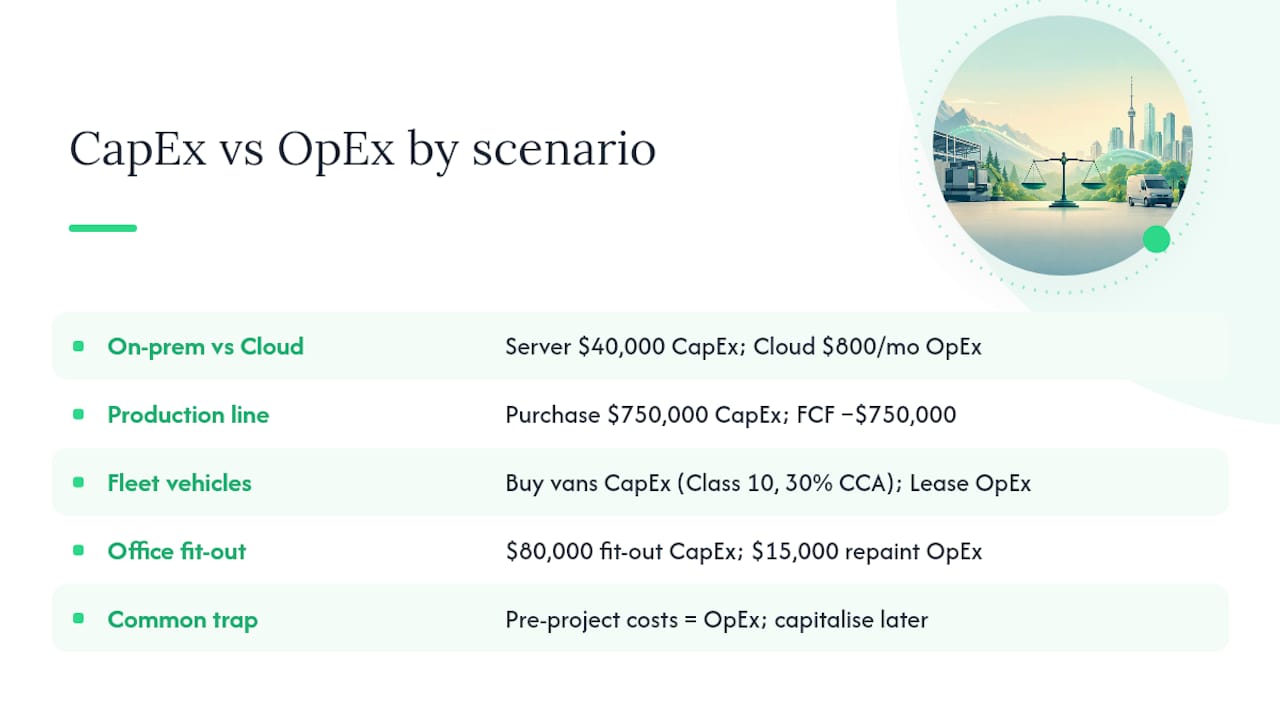
A professional services firm needs 50 TB of storage. Buying a physical server for $40,000 is CapEx: capitalise it, claim CCA (likely Class 50 at 55%), and show it as an investing outflow. Subscribing to cloud storage at $800/month is OpEx: $9,600 deducted this year, no asset on the balance sheet. Shifting to OpEx through cloud services can materially change procurement speed, scalability and near-term liquidity, even if the total five-year cost is higher. The cloud option also keeps your balance sheet lighter, which can improve leverage ratios.
Scenario 2: Buying a production line
A manufacturer purchases a $750,000 automated assembly line. This is unambiguously CapEx. The machine goes on the balance sheet, EBITDA is unaffected in year one, but free cash flow drops by $750,000. Over the following years, CCA deductions reduce taxable income. The lender financing the purchase will want to see a depreciation schedule, a replacement plan, and confirmation that debt service coverage holds under a downside revenue scenario.
Scenario 3: Fleet vehicles
Purchasing delivery vans outright is CapEx (CRA Class 10, 30% CCA). Leasing the same vans under an operating lease is OpEx: monthly payments hit the income statement, no asset appears on the balance sheet. The lease route improves near-term cash flow and simplifies disposal, but you build no equity in the vehicles.
Common trap: Capitalising planning and feasibility costs for a project that never reaches the application-development stage is a frequent error. Pre-project costs, including architectural drawings that are later abandoned or internal scoping hours, are generally OpEx. Only costs incurred once a project is approved and actively being built or developed qualify for capitalisation.
Scenario 4: Office fit-out
A retailer spends $80,000 renovating leased space. Leasehold improvements that extend beyond the lease term or add lasting value are CapEx. Short-term cosmetic work that simply restores the space is OpEx. The distinction matters: the $80,000 CapEx version spreads the deduction over years, while a correctly classified $15,000 maintenance repaint is gone from taxable income this year.
What lenders and investors look for in your CapEx vs OpEx choices
When a lender opens your financials, they are not just checking whether you can service the debt today. They are asking whether your capitalisation policy is consistent, your depreciation assumptions are realistic, and whether your EBITDA is a fair representation of operating performance.
Key things lenders examine:
- Capitalisation policy: Is it written down? Is it applied consistently year over year? Inconsistency is a red flag.
- Depreciation and useful life assumptions: Are you depreciating assets over a realistic period, or stretching useful lives to keep depreciation charges low and EBITDA high?
- Replacement cycles: Asset-heavy businesses need a credible plan for replacing equipment. A lender financing a $2M equipment purchase wants to see that you have modelled the next replacement.
- Debt service coverage ratio (DSCR): Heavy CapEx financed by debt increases interest and principal obligations. Lenders will stress-test your DSCR under lower-revenue scenarios.
- Covenant triggers: Many loan agreements include covenants tied to leverage ratios or minimum EBITDA. A large CapEx decision that increases debt or a reclassification that reduces EBITDA can trip a covenant.
How Canadian lenders score your business plan is directly tied to the quality and consistency of your financial assumptions, including how you classify and depreciate capital assets.
Pro Tip: When preparing a lender pack, include a one-page capitalisation policy summary alongside your financial statements. State your threshold, the CCA classes you use, and your depreciation method. Lenders who see this document understand immediately that your numbers are not improvised, which builds confidence faster than any cover letter.
How to budget and forecast CapEx and OpEx
CapEx and OpEx planning require different rhythms and different levels of governance.
Suggested annual cadence:
- September to October: Identify CapEx needs for the coming year. Gather quotes, confirm CCA classes, and model depreciation impact on the P&L and cash flow.
- October to November: Submit CapEx requests for formal approval. Include a business case, useful life estimate, and financing recommendation (cash, loan, or lease).
- November to December: Finalise the OpEx operating budget. Build in salary increases, contract renewals, and known subscription changes.
- January: Lock both budgets. Establish a monthly tracking process to flag variances early.
Forecasting checklist:
- Include CCA deductions by class in your tax provision and cash flow model.
- Build a multi-year depreciation schedule showing UCC balances and annual charges.
- Model replacement cycles for major assets (fleet, equipment, technology).
- Add a contingency line (typically 10–15% of CapEx budget) for cost overruns.
- Include vendor service and maintenance costs as OpEx in years following a CapEx purchase.
Presenting CapEx in lender packs: Your cash flow forecast should separate operating cash flows from investing cash flows clearly. Lenders want to see that your operating cash generation covers debt service before you layer in CapEx. Stress-test your model at 80% and 60% of projected revenue to show the business remains viable under pressure.
CapEx approvals tend to involve more stakeholders and longer timelines than OpEx decisions. Build that lead time into your procurement schedule so a delayed approval does not stall operations.
A note from the LenderReady team
The CapEx vs OpEx question comes up in almost every business plan we review. Owners often know intuitively what they spent money on; the challenge is translating that into the language a lender or CRA auditor expects to see. We help clients document their capitalisation policy, build CCA schedules into their financial models, and present CapEx decisions in a way that helps rather than complicates a loan application. If you are preparing financials for a lender and you are unsure whether a purchase should be capitalised or expensed, that uncertainty is worth resolving before you submit, not after. LenderReady’s AI-powered business plan tool builds rigorous financial models, including depreciation assumptions and DSCR analysis, so your numbers hold up under scrutiny. You can also compare it to a generic AI prompt to see why lender-ready output requires more than a quick chat session.

Sources
The following resources were used in preparing this article or are recommended for deeper reference. Canada-focused sources are noted.
- capitalized expenditure | Wex | US Law | LII / Legal Information Institute
- CapEx vs. OpEx: Key Differences Explained - Investopedia
- CapEx vs. OpEx: Key Differences and Business Impact - phoenixNAP
- CapEx vs. OpEx vs. COGS: Key Differences Explained | CO - US Chamber of Commerce
- Capex vs. Opex - Wall Street Prep
- What Is CapEx vs OpEx? | Eightx
This article provides general information about CapEx and OpEx classification and Canadian tax concepts. It is not a substitute for professional accounting or tax advice. Confirm CCA classes, rates, and eligibility with the CRA or a qualified Canadian tax professional before making filing decisions.
See where your financing file stands
Fifteen questions, four minutes, no documents and no email. You get a readiness stage, the gaps a lender would raise, and the document list for your request.
Check my readiness, freeLenderReady is an educational service, not a lender, broker, or financial advisor. Lending criteria vary by institution and change over time; treat this as a starting point, not a guarantee.