Fast business plan: one-page template plus a 15-minute workflow

A usable business plan can be finished in 15 to 60 minutes if you build it around a one-page format and a timed workflow instead of a traditional narrative document. The Small Business Administration’s guidance backs this up: lean startup plans can take as little as one hour to write, and the format you choose should fit your purpose, not some inherited template from a business school textbook. Free one-page templates already exist for exactly this reason. If you want the fastest possible route to a lender-ready plan, a conversational AI tool like LenderReady from LenderReady can produce a tailored draft in about 15 minutes.
Here are the eight sections a fast plan needs, each one to three sentences long:
- Problem or opportunity, what gap in the market you’re addressing, and for whom.
- Solution or value proposition. What you’re building and why it beats the alternatives.
- Target market, who buys, how big that group is, and how you’ll reach them.
- Revenue model. How money comes in: subscriptions, one-time sales, service fees.
- Competitive advantage, the one or two things a competitor can’t easily copy.
- Marketing strategy, the two or three channels you’ll actually use first.
- Financial summary. Revenue forecast, costs, and the break-even point.
- Funding or next steps, what you need, how much, and what it buys you.
Pro Tip: Set a 15-minute timer per section pass. When it goes off, move to the next section even if the current one feels unfinished. A rough version of all eight sections beats a polished version of three.
Key takeaways
The fastest reliable path to a usable business plan combines a one-page template with a timed workflow, and upgrading to an AI tool like LenderReady cuts that timeline to about 15 minutes when lender-grade financials are required.
| Point | Details |
|---|---|
| Start with the one-page format | Use eight short sections, one to three sentences each, instead of a long narrative document. |
| Time-box your draft | Run a 15-minute rapid pass or a 60-minute fuller version, and stop when the timer ends. |
| Build the lender financial snapshot | Include a 12-month forecast, gross margin, cash runway, funding need, and a break-even or DSCR note. |
| Revise on a schedule | Update the plan after customer interviews or at least once a month during early traction. |
| Upgrade when financials get complex | LenderReady from LenderReady generates a tailored, lender-ready plan in about 15 minutes when a template’s modelling isn’t enough. |
Table of Contents
- What a fast one-page business plan contains
- A copy-and-paste template you can use right now
- How to write a fast business plan in 15 to 60 minutes
- Making a short plan lender-ready: the financials that matter
- Choosing the right tool: templates, builders, or AI
- Why fast plans win, and when to slow down
- The fastest path to a lender-ready plan: LenderReady
- Sources
What a fast one-page business plan contains
A one-page plan works because it forces every sentence to do a job. There’s no room for throat-clearing or a three-paragraph mission statement nobody will read twice. The SBA distinguishes traditional detailed plans from lean startup plans, and it recommends the lean format specifically for founders who need to move fast and revise often.
Each of the eight core sections earns its place through specificity, not length. The problem section should name a real pain point you’ve observed, not a generic market gap. The revenue model needs an actual number: “$49/month subscription” beats “recurring revenue model” every time. Financial summaries work best as a compact table with three lines: revenue, cost, and margin.
Who reads your plan changes what you emphasize. A lender wants the financial summary and funding sections front-loaded with hard numbers, because that’s what determines repayment capacity. An angel investor cares more about traction and unit economics: how many customers you have, what it costs to acquire one, and what that customer is worth over time. Internal plans, the kind you write for a co-founder or a new hire, can lean harder on strategy and lighter on formal financials.
Watch for these common failures in fast plans:
- Writing a paragraph where a single number would communicate more.
- Leaving the revenue model vague (“we’ll monetize through various channels”).
- Skipping the assumptions behind a forecast, so nobody can judge if it’s realistic.
- Padding the competitive advantage section with adjectives instead of facts.
A copy-and-paste template you can use right now
Paste this into Word, Google Docs, or an AI drafting tool and start filling in blanks immediately.
Business name and one-line description: What you do, in one sentence a stranger would understand.
Problem/opportunity: The specific gap or pain point you’re solving, and evidence it’s real.
Solution/value proposition: What you offer and the one reason someone chooses it over the next best option.
Target market: Who buys, roughly how many of them exist, and how you’ll find the first ones.
Revenue model: How you charge and what a typical sale or subscription is worth.
Competitive advantage: The thing a competitor cannot copy quickly, whether that’s a relationship, a process, or a cost structure.
Marketing strategy: The two or three channels you’ll test first, with a rough budget or time commitment.
Financial summary: 12-month revenue forecast, major costs, and the point where revenue covers expenses.
Funding/next steps: What you need, what it’s for, and the milestone it unlocks.
The template flexes depending on who’s reading it. For a lender, expand the financial summary line into three sub-lines covering revenue, gross margin, and cash runway. For an investor, add a sentence under target market naming your current customer count or waitlist size. For internal use, you can shrink the funding section to a single line, or drop it entirely if you’re not raising money right now.
HubSpot’s free one-page template follows this same eight-section structure with fillable fields, and LenderReady’s own one-page business plan guide walks through the same format with Canadian-specific examples if you want a second reference point before you commit to wording.
How to write a fast business plan in 15 to 60 minutes
Pick your timebox based on what you actually need today: a rough draft to organize your own thinking, or a fuller document you’re about to hand to someone else.
Before you start, gather three things:
- Your top one or two customer segments, described in plain language.
- A pricing example: what you’ll charge and for what unit of value.
- A rough revenue estimate for month one, even if it’s a guess.
The 15-minute rapid draft:
- Write the problem and solution sections together (3 minutes). They’re really one idea split in two.
- Name your target market and revenue model (3 minutes).
- State your competitive advantage in one sentence (2 minutes).
- List two marketing channels you’ll actually try (2 minutes).
- Drop in your rough revenue number and biggest cost (3 minutes).
- Write one line on what you need next, whether that’s funding or a first customer (2 minutes).
The 60-minute fuller version:
- Complete the 15-minute draft above as your skeleton (15 minutes).
- Spend 10 minutes checking your target market claim against a quick search: does the size or need you’re assuming actually hold up?
- Sharpen the revenue model with a specific price point and expected volume (10 minutes).
- Build a simple three-line financial summary: revenue, cost, margin (15 minutes).
- Write the funding or next-steps section with a specific dollar figure and its purpose (10 minutes).
Awasero’s one-page guide proposes a useful forcing function here, sometimes called the three-hour rule: if a first plan takes longer than three hours, you’re probably stalling rather than genuinely researching. That’s a fair diagnostic. If you’re stuck past your timebox, the block usually isn’t a writing problem. It’s that you don’t yet know your customer or your numbers well enough, and no amount of extra drafting time fixes that.
Pro Tip: After your first timed pass, take a five-minute break, then run one more 15-minute revision. Fresh eyes catch the vague sentence you didn’t notice you’d written the first time through.

Making a short plan lender-ready: the financials that matter
A one-page plan can absolutely satisfy a lender, but only if the financial section carries real weight instead of vague optimism. Lenders reading a short plan are scanning for six things, and if any is missing, expect a follow-up request that slows down your application.
- 12-month revenue forecast, monthly or quarterly, with the assumption behind the growth curve stated in one line.
- Gross margin or unit economics. What it costs to deliver one unit of your product or service against what you charge for it.
- Cash runway, how many months your current cash covers expenses at your projected burn rate.
- Startup or operating costs, the real dollar figure, broken into two or three major categories.
- Funding needed and use of funds, the exact amount and where each dollar goes.
- Break-even point or a simple debt service coverage ratio (DSCR) note, for a loan application specifically, showing you can service the debt from projected cash flow matters more than almost anything else on the page.
Say what your assumptions rest on.
Picture a small bakery seeking a $40,000 equipment loan. That’s a complete lender snapshot in four sentences. For a deeper walkthrough of how to build out DSCR and sensitivity modelling for a bank application, LenderReady’s business plan financials guide covers the mechanics in more depth than a one-pager can hold.

Choosing the right tool: templates, builders, or AI
Four tool categories cover almost every fast-plan scenario, and picking the right one comes down to how much tailoring you need and how much time you actually have.
- Free downloadable templates (Word, PDF, Google Docs), fastest to start, zero cost, but you do all the thinking yourself.
- Interactive builders, guided fields and prompts that walk you through each section, useful if you tend to freeze up in front of a blank page.
- Simple spreadsheet templates, built specifically for the financial summary, handy when your plan’s weakest point is the numbers rather than the narrative.
- AI generators like LenderReady, conversational input in, a tailored draft out, with financial modelling built in rather than bolted on afterward.
Use this to decide fast:
- If you need something in the next ten minutes and your numbers are simple, grab a downloadable template.
- If you’re not confident about what belongs in each section, an interactive builder reduces the odds of leaving something out.
- If your financials are the shaky part, start with a spreadsheet template built for forecasting rather than trying to eyeball it in a text document.
- If you need rigorous lender modelling, such as a DSCR calculation or a documented sensitivity analysis, a template alone usually can’t get you there, and that’s the point where upgrading to an AI plan generator pays off.
General-purpose chat AI tools can draft plan text quickly, but they don’t apply consistent lender-grade financial logic across drafts. LenderReady’s comparison of ChatGPT against LenderReady breaks down exactly where a purpose-built plan tool pulls ahead of a general chatbot on financial rigour. If you’re leaning on generic AI output for now, a quick sanity check against a dedicated business plan prompt guide helps close some of that gap before you send anything to a lender.
Why fast plans win, and when to slow down
Speed is a diagnostic tool disguised as a shortcut. Forcing yourself into a 15-minute or 60-minute window doesn’t just save time, it exposes exactly where your business thinking is thin. If the revenue model section takes four times longer than everything else, that’s not a writing problem. That’s your business telling you it doesn’t yet know how it makes money with any confidence.
I’d push back on the instinct to treat a fast plan as a lesser draft you’ll “properly” write later. In practice, most founders never go back and write the long version, and they don’t need to. A one-page plan that’s been revised three times after real customer conversations beats a fifteen-page document written once and never touched again. The plan’s value comes from how often it gets updated, not how long it was on day one.
That said, speed has limits. When a lender specifically requests a detailed cash flow statement, a multi-year projection, or documentation behind your assumptions, that’s not the moment to hand over a one-pager and hope it’s enough. Bank underwriters and investors doing real due diligence want the depth a lean format deliberately skips. Treat those requests as a cue to expand specific sections, not a signal that your fast plan was wrong to begin with.
Set a revision cadence and stick to it: update the plan after every batch of customer interviews, or at minimum once a month while you’re still finding product-market fit. A plan that hasn’t changed in three months usually means either the business has stalled or the founder has stopped checking it against reality.
The fastest path to a lender-ready plan: LenderReady
LenderReady built LenderReady for the exact moment a template stops being enough: when you need lender-grade financial modelling but don’t have days to spend building it from scratch. LenderReady is a conversational AI tool that turns a short Q&A session into a tailored, lender-ready plan in about 15 minutes, complete with the financial rigour a one-pager alone can’t deliver, including DSCR calculations, sensitivity analysis, and documented assumptions.
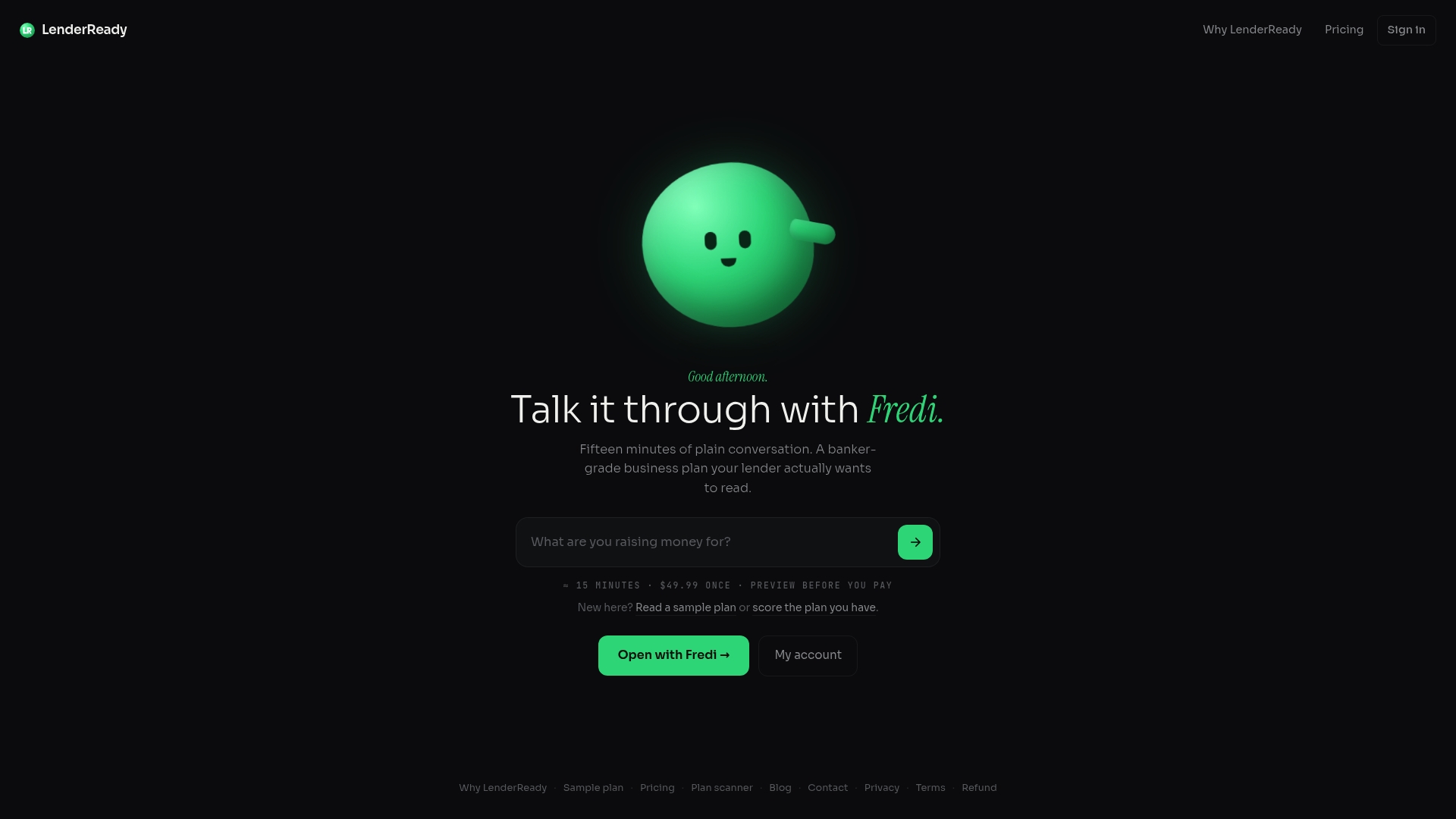
The practical benefits stack up quickly for anyone under time pressure. You get instant feedback as you answer questions, unlimited revisions instead of a one-shot draft, and the option to add a paid human banker review before you submit anything to a lender. Picture a founder who needs a pre-application plan finished before a Monday meeting: a Friday-afternoon session with LenderReady replaces what would otherwise be a weekend spent wrestling with spreadsheets and formatting.
If you’re not sure your current draft would pass muster, start with LenderReady’s free plan readiness scan to see where it stands before you commit to anything paid. It’s a low-friction way to find out whether you need a full rebuild or just a sharper financial section.
Sources
The SBA’s business planning guidance is the best starting point for understanding when a lean format is appropriate versus when a lender or investor will expect the traditional detailed version. HubSpot’s free one-page template gives you a downloadable file with the eight sections already labelled, useful if you want to start typing immediately rather than building a template from scratch.
Forbes Advisor’s simple business plan template makes the case for starting plain and focusing on the big picture rather than overthinking the first draft, which pairs well with the timed workflow above. Awasero’s one-page guide is worth a look specifically for its three-hour rule if you tend to over-polish early drafts.
For readers ready to go deeper on the lending side, LenderReady’s step-by-step bank loan guide walks through exactly what underwriters expect once your plan moves past the one-page stage. If you’re building toward a pitch deck rather than a loan application, BabyLoveRaise’s founder guide to pitch deck consultants is a solid next stop once your one-pager needs to become an investor presentation.
How long does it actually take to write a fast business plan? A rough one-page draft can take only minutes if you already know your customer and your pricing. A fuller version with a sharpened financial summary typically requires more time. The SBA notes lean startup plans can be very fast to complete, which matches this range.
What’s the difference between a quick business plan and a traditional one? A quick or lean plan compresses a business plan into roughly one page covering eight core areas, while a traditional plan runs many pages with detailed market research, multi-year financials, and appendices. Lean formats suit fast-moving founders and internal planning; traditional formats suit some loan applications and formal investor due diligence.
Can a one-page plan really satisfy a lender? It can, provided the financial section includes a 12-month revenue forecast, gross margin, cash runway, and a clear statement of funding needed and use of funds. Lenders care more about clarity and credible assumptions than page count.
When should I upgrade from a free template to an AI-generated plan? Upgrade when your financials need rigour a spreadsheet template can’t easily provide, such as a documented DSCR calculation or a sensitivity analysis showing how your numbers change under different assumptions. That’s the point where a tool like LenderReady typically saves more time than it costs.
How often should I update my fast business plan? Treat it as a living document. Revise it after every round of customer conversations, or at minimum once a month while you’re still establishing product-market fit. A plan that hasn’t changed in months is usually a sign the business has stalled, not that the plan is finished.
- Plan your business - Small Business Administration
- Free One Page Business Plan - Word, PDF | HubSpot
- One-Page Business Plan Template, Free, No Signup Required | Awasero
See where your financing file stands
Fifteen questions, four minutes, no documents and no email. You get a readiness stage, the gaps a lender would raise, and the document list for your request.
Check my readiness, freeLenderReady is an educational service, not a lender, broker, or financial advisor. Lending criteria vary by institution and change over time; treat this as a starting point, not a guarantee.