Loan proposal format: the lender-ready Canadian guide

A lender-ready loan proposal follows this exact sequence: executive summary, company overview, market analysis, products and services, operations, management team, funding request, financial statements and projections, collateral, and appendix. That order is not arbitrary. It mirrors the way a credit officer reads, and getting it right is the difference between a quick approval and a request for “more information” that stalls for weeks.
Before you write a single word, know your targets:
- Executive summary: 1–2 pages, written last, placed first
- Full proposal length: 20–30 pages for comprehensive requests, per BDC guidance
- Financial projections: 3–5 years of annual statements plus 12 months of monthly cash-flow detail
- Source documents: attached as a labelled appendix, not buried in the body
If you want a head start, the one-page loan summary every banker wishes you’d include is the single fastest way to make your proposal stand out before the credit officer even opens the main document.
Table of Contents
- What does a loan proposal format look like, section by section?
- What financial statements do lenders actually require?
- How do you write the funding request and repayment plan?
- What do Canadian lenders look for? The five C’s of credit
- How should you present the proposal to make it easy to approve?
- A copy-paste executive summary and funding request you can adapt
- Where can you find templates and tools that work for Canadian lenders?
- What documents do you need to attach to the loan proposal?
- Research-backed tips that make your proposal stand out
- Key takeaways
- What most proposals get wrong (and how to fix it)
- LenderReady builds your lender-ready proposal in 15 minutes
- Useful sources for Canadian loan proposal preparation
What does a loan proposal format look like, section by section?
A business loan proposal is not the same as a business plan, though the two overlap. A business plan describes where your company is going. A loan proposal makes a specific financial argument: here is the money I need, here is exactly what I will do with it, and here is how you will get paid back. Every section below serves that argument.
-
Executive summary The lender reads this first and often decides whether to continue based on it alone. State the loan amount, the term you are requesting, the purpose of the funds, and your primary repayment source. Keep it to one or two pages. Write it last, once you know every number in the document.
- Loan amount and term (e.g., “$250,000 over 60 months”)
- Purpose in one sentence (“to purchase CNC equipment and fund three months of working capital”)
- Primary repayment source (“operating cash flow from existing contracts”)
- Brief company snapshot: years in business, revenue, number of employees
-
Company overview Give the lender context about who you are. Include your legal name, business number, incorporation date, province of registration, and ownership structure. A sentence or two on your history and what makes your business defensible in its market is enough.
- Legal entity type (corporation, sole proprietorship, partnership)
- CRA business number and GST/HST registration
- Ownership percentages and any related-party relationships
-
Market analysis This section answers the question a credit officer is quietly asking: “Is there actually a market for this?” You do not need a 10-page academic study. A focused two-page summary of your target market size, key competitors, and your competitive position is sufficient. Use Statistics Canada data or industry association reports where available.
- Total addressable market and your realistic share
- Two or three named competitors and your differentiation
- Any relevant trends (e.g., population growth in your service area, regulatory tailwinds)
-
Products and services Describe what you sell, your pricing model, and your gross margin. Lenders want to understand the unit economics before they look at the financials.
- Product or service description in plain language
- Pricing and margin (e.g., “average ticket $4,200, cost of goods 38%”)
- Key suppliers and any supply-chain dependencies
-
Operations Explain how the business runs day to day. Include your location, key equipment, production capacity, and any licences or permits required to operate. If you are buying equipment with the loan, describe it here and reference the vendor quote in the appendix.
- Physical location(s) and lease terms
- Key equipment and technology
- Regulatory licences (municipal, provincial, federal)
-
Management team Banks lend to people as much as to businesses. A one-paragraph bio for each key person, focused on relevant experience, is more persuasive than a résumé dump. If your team has a gap, name it and explain how you will fill it.
- Name, title, and years of relevant experience
- Prior business ownership or industry credentials
- Any advisory board members or key outside advisors
-
Funding request State the exact dollar amount, the loan structure you are seeking (term loan, line of credit, equipment financing), the proposed term, and your interest-rate assumption. Then break down every dollar in a use-of-proceeds table. This section is where the Shopify business plan template and similar guides converge: the funding request must link directly to repayment logic, not float as a standalone ask.
- Loan amount and structure
- Proposed term and amortization
- Use-of-proceeds table (see Section 4 for a sample)
- Primary and secondary repayment sources
-
Financial statements and projections This is the section lenders spend the most time on. Include historical statements for the past 2–3 years (if available) and forward projections covering 3–5 years annually, plus 12 months of monthly cash-flow detail. Full guidance is in Section 3.
-
Collateral List every asset you are offering as security: real property (with estimated value and any existing encumbrances), equipment, accounts receivable, inventory, and personal guarantees. Be specific. “Various business assets” tells a lender nothing. For detailed guidance on what Canadian lenders accept, see what collateral you need for a business loan in Canada.
- Asset description, estimated value, and any existing liens
- Personal guarantee: guarantor name, net worth summary
- Third-party appraisals or insurance certificates (in appendix)
- Appendix Keep the body clean. Move source documents here and label every item clearly (e.g., “Appendix A: Equipment Quote: ABC Machinery, March 2026”). The appendix is where tax returns, leases, contracts, photos, and résumés live. Reference each appendix item by letter in the body.
What financial statements do lenders actually require?
The financials section is where most proposals fall short, not because entrepreneurs lack the numbers, but because they present them in the wrong format or leave out the assumptions. Canadian lenders, whether a chartered bank, a credit union, or the BDC, expect a specific package.
Historical statements
For an existing business, provide the last 2–3 years of:
- Income statements (profit and loss)
- Balance sheets
- Cash-flow statements
If your financials are unaudited, note that clearly and use the same accounting basis (accrual or cash) throughout. CRA-filed T2 corporate returns or T1 personal returns serve as the authoritative version; lenders will cross-reference them.
Projections
Lenders expect three to five years of annual projections and at least 12 months of monthly cash-flow detail. The monthly detail is what the credit officer uses to assess whether you can make your first year of loan payments without a cash crisis.
Sample monthly cash-flow stub (Year 1, Q1)
| Line item | January | February | March |
|---|---|---|---|
| Revenue | , | $45,000 | , |
Key ratios lenders calculate
Debt Service Coverage Ratio (DSCR): Annual net operating income divided by total annual debt payments. Most Canadian lenders want a DSCR of at least 1.25, meaning your business generates $1.25 in operating income for every $1.00 of debt payment. Document this calculation explicitly in your proposal.

Current ratio: Current assets divided by current liabilities. A ratio above 1.0 signals you can cover short-term obligations.
Debt-to-equity: Total liabilities divided by total equity. A lower ratio signals less financial risk to the lender.
Assumptions table
Every projection needs a companion assumptions table. Lenders do not trust numbers that appear without explanation.
| Assumption | Value | Basis |
|---|---|---|
| Revenue growth, Year 1 | 12% | Signed contracts on hand |
| Revenue growth, Years 2–3 | 8% per year | Industry average, Statistics Canada |
| Gross margin | 38% | Historical average, last 3 years |
| Operating expense inflation | 3% per year | CPI estimate |
| Loan interest rate | 7.5% | Prime + 2.5%, current prime rate |
| Capital expenditure, Year 1 | , | Vendor quote, Appendix A |
Lenders prefer conservative assumptions over optimistic ones. If your revenue growth assumption is higher than your historical average, explain why in a sentence.
How do you write the funding request and repayment plan?
The funding request is the heart of the proposal. A vague ask (“we need approximately $300,000”) signals to a lender that you have not thought through the project. A precise, well-structured request signals the opposite.
Sample funding request paragraph
“[Business Name] is requesting a $250,000 term loan over 60 months at an assumed interest rate of 7.5% per annum. Funds will be used to purchase two CNC machining centres ($185,000), fund three months of working capital ($45,000), and cover closing and installation costs ($20,000). The primary repayment source is operating cash flow from existing purchase orders totalling $1.2 million annually. A personal guarantee from [Owner Name] will be provided as secondary security.”
That paragraph answers every question a credit officer has before they open the financial schedules.
Use-of-proceeds table
The BMO financial proposal guide and similar bank-side checklists consistently flag use-of-proceeds as a required element. Break every dollar down.
| Category | Amount | Notes |
|---|---|---|
| Equipment purchase | $185,000 | Two CNC machining centres, vendor quote attached |
| Working capital | $45,000 | Three months of operating expenses |
| Leasehold improvements | , | Electrical upgrades for new equipment |
| Installation and freight | , | Vendor estimate |
| Total | $250,000 |
Repayment plan guidance
- State the amortization period and whether you are requesting an interest-only period at the start (common for construction or pre-revenue phases).
- Show the monthly payment amount and confirm it is covered by your DSCR calculation.
- If you are requesting a line of credit rather than a term loan, explain the seasonal pattern that drives drawdowns and repayments.
- For government programs like the Canada Small Business Financing Program, note that specific program terms and eligibility rules apply and confirm current requirements with the lender or the Government of Canada directly.
A 60-month term at 7.5% on $250,000 produces a monthly payment of roughly $5,009. Showing that your projected monthly net operating income covers that payment with room to spare is the single most persuasive thing you can put in the proposal.
What do Canadian lenders look for? The five C’s of credit
Every Canadian lender, from a Big Six bank to a local credit union to the BDC, evaluates loan proposals through the same framework: the five C’s of credit. Understanding what each one means in practice, and what documents address it, lets you build a proposal that answers the lender’s questions before they ask them. For a deeper look at how Canadian lenders score your business plan, the scoring criteria are more specific than most entrepreneurs expect.
Character
This is the lender’s assessment of your integrity and track record. It is partly subjective, which is why the personal elements of your proposal matter more than people think.
- Personal credit report (aim for 680+ for most bank products)
- Management bios highlighting relevant experience
- References from suppliers, customers, or professional advisors
- A clear, honest explanation of any past credit issues
Capacity
Can your business generate enough cash to repay the loan? This is where your DSCR calculation lives.
- DSCR calculation, shown explicitly (minimum 1.25 for most lenders)
- 12-month monthly cash-flow projection
- Contingency plan: what happens if revenue comes in 15–20% below forecast?
Capital
How much of your own money is in the deal? Lenders want to see that you have skin in the game.
- Owner equity contribution as a percentage of total project cost
- Retained earnings on the balance sheet
- Any subordinated debt or shareholder loans
Collateral
What assets back the loan if repayment fails? Be specific and realistic about values.
- List of assets with estimated market values and existing liens
- Personal guarantee with a brief net-worth summary
- Third-party appraisals for real property
Conditions
This covers the purpose of the loan, the state of the industry, and the broader economic environment.
- Clear statement of loan purpose tied to a specific business outcome
- Brief industry outlook (one paragraph, sourced from a credible report)
- Any regulatory or market conditions that affect repayment risk
Pro Tip: Credit unions and government programs like BDC often have more flexibility on collateral and capital requirements than chartered banks, but they still apply the five C’s. Tailor your proposal to the specific lender: a credit union may weigh community impact and character more heavily, while a bank’s credit team will focus almost entirely on capacity and collateral. Knowing your audience before you write saves significant revision time.
Decision timelines vary by lender type. A chartered bank typically takes 2–6 weeks from submission to decision for a small-business loan. Credit unions can move faster, sometimes in 1–2 weeks. BDC decisions on standard loans generally take 3–5 weeks. Government-backed programs through Innovation, Science and Economic Development Canada can take longer depending on the program.
How should you present the proposal to make it easy to approve?
A well-structured proposal that is hard to read is still a problem. Credit officers review dozens of files. A proposal that is clear, clean, and easy to navigate gets read more carefully than one that requires effort to parse.
Language and length
Plain language is not a style preference; it is a strategic choice. BDC recommends that comprehensive loan proposals run 20–30 pages, with the executive summary at 1–2 pages. That range assumes a full set of financial schedules. A simpler request for a small line of credit might be 10–15 pages.
- Write in active voice: “We will use the funds to purchase equipment” not “Funds will be utilized for the purpose of equipment acquisition.”
- Avoid acronyms unless you define them on first use.
- Use the same terminology throughout: if you call it “net operating income” in the assumptions table, do not switch to “EBIT” in the narrative.
A copy-paste executive summary and funding request you can adapt
The samples below follow the SBDC sample loan proposal structure and the PandaDoc template conventions, adapted for Canadian lenders. Replace every bracketed item with your own details.
One-page executive summary sample
[Business Legal Name] Loan Proposal: Executive Summary
Business: [Business Legal Name] is a [province]-registered [corporation/sole proprietorship] operating in the [industry] sector since [year]. The business employs [number] full-time staff and generated revenue of $[amount] in its most recent fiscal year.
Loan request: We are requesting a $[amount] [term loan / line of credit / equipment loan] over [term in months] months at an assumed rate of [X]% per annum.
Purpose: Funds will be used to [one-sentence description, e.g., “purchase two commercial refrigeration units and fund 60 days of additional inventory ahead of the summer season”].
Repayment source: The loan will be repaid from operating cash flow. Projected annual net operating income of $[amount] carries a DSCR of [X.XX], comfortably above the 1.25 threshold.
Collateral: Security will include [list assets, e.g., “a first charge on business equipment valued at $[amount] and a personal guarantee from [Owner Name]”].
Owner: [Owner Name], [title], has [X] years of experience in [industry]. [One sentence on relevant background.]
One-page funding request sample
Funding Request, [Business Legal Name]
Amount requested: $[amount]
Structure: [Term loan / revolving line of credit / equipment financing]
Term: [X] months
Amortization: [X] months (with / without an interest-only period of [X] months)
Interest assumption: [X]% per annum (prime + [X]%)
Use of proceeds:
| Category | Amount |
|---|---|
| [Equipment / machinery] | $[amount] |
| [Leasehold improvements] | $[amount] |
| [Inventory] | $[amount] |
| [Working capital] | $[amount] |
| [Professional fees / closing costs] | $[amount] |
| Total | $[amount] |
Repayment narrative: Monthly payments of approximately $[amount] will be funded from operating cash flow. Based on Year 1 projections, net operating income of $[amount] covers total annual debt service of $[amount], producing a DSCR of [X.XX].
Notes for tailoring by lender type:
- Chartered banks (RBC, TD, BMO, Scotiabank, CIBC, National Bank):: Emphasise DSCR, collateral values, and personal credit score. Banks want hard numbers and will verify every figure.
- BDC and government programs:: Reference the specific program you are applying to (e.g., Canada Small Business Financing Program) and confirm current eligibility criteria directly with BDC or the Government of Canada, as program terms change.
Where can you find templates and tools that work for Canadian lenders?
Templates save time on structure, but they can mislead you if you treat the example numbers as placeholders to fill in rather than as figures to replace with verified, defensible data. The PandaDoc bank loan proposal template is a solid starting point for layout and table of contents structure. The SBDC sample loan proposal provides a more detailed financial schedule format that maps closely to what Canadian lenders expect.
Template types and when to use each:
- Financial model spreadsheets (Excel or Google Sheets):: Use for income statements, balance sheets, cash-flow projections, and ratio calculations. Build your own or adapt a template, but every formula must be traceable.
For Canadian applicability, BDC’s own resources are the most directly relevant, since BDC guidance reflects what Canadian chartered banks and credit unions also expect. Provincial variations exist, particularly for Quebec (where Investissement Québec has its own requirements) and for businesses applying to provincial programs in Ontario, Alberta, or British Columbia. Always confirm program-specific requirements with the administering body.
If you are preparing a pitch alongside your proposal, a custom pitch deck consultant can help you translate the proposal’s financial narrative into a slide format for investor or advisory board presentations.
For a bank loan business plan guide specific to Canada, the documentation expectations for chartered banks are laid out in detail, including what to prepare when you have less than two years of operating history.
What documents do you need to attach to the loan proposal?
A strong proposal body with a weak appendix is a common reason for delays. Lenders will ask for missing documents, and every round-trip adds weeks. Assemble everything before you submit.
Document checklist
Personal documents (all owners with 20%+ ownership):
- Last 2–3 years of personal tax returns (T1 General with all schedules)
- Personal net-worth statement (assets, liabilities, net worth)
- Personal credit report (some lenders pull this themselves; others ask you to provide it)
- Government-issued photo ID
Business financial documents:
- Last 2–3 years of corporate tax returns (T2) or business income schedules
- Last 2–3 years of financial statements (income statement, balance sheet, cash-flow statement)
- Most recent interim financial statements (within 90 days of submission)
- Aged accounts receivable and accounts payable schedules
Operational documents:
- Business licence and any industry-specific permits or certifications
- Lease agreements for all business premises
- Key customer contracts or purchase orders (redacted if confidential)
- Supplier agreements for any major inputs
- Equipment quotes or purchase agreements (for equipment financing)
Management documents:
- Résumés for all key management team members
- Shareholder agreement (for corporations with multiple owners)
- Articles of incorporation and certificate of incorporation
Final pre-submission checks
- Confirm that every number in the narrative matches the financial schedules exactly. A revenue figure that differs by even $1,000 between the executive summary and the income statement raises questions.
- Verify that every use-of-proceeds line item has a source quote or estimate in the appendix.
- Label every appendix item clearly and list them in a table of contents at the start of the appendix.
- Check that your DSCR calculation uses the same net operating income figure that appears in your projected income statement.
- Read the executive summary aloud. If it takes more than two minutes to read, it is too long.
Research-backed tips that make your proposal stand out
Most proposals cover the basics. The ones that get approved quickly go further, not by adding more pages, but by anticipating the credit analyst’s questions and answering them before they are asked. Banks use the proposal to build an internal credit memo, a concise decision document that summarises the borrower, the loan terms, the financial analysis, and the key risks and mitigants. Borrowers who structure their proposals to make that job easier get faster decisions.
Sensitivity analysis
Include a one-page downside scenario alongside your base-case projections. Show what happens to your DSCR if revenue comes in 15% below forecast, or if your key customer reduces orders. A proposal that acknowledges risk and shows the business survives it is far more credible than one that presents only the optimistic case.
Risk-and-mitigation table
Pro Tip: Add a short risk-and-mitigation table near the end of your financial section. A credit analyst will build one anyway as part of the credit memo. Giving them a draft saves time and lets you frame the risks on your terms.
| Risk | Likelihood | Mitigation |
|---|---|---|
| Key customer concentration (top customer = 40% of revenue) | Medium | Three additional contracts in negotiation; customer has 5-year history |
| Equipment delivery delay | Low | Vendor confirms 6-week lead time; working capital buffer covers gap |
| Interest rate increase | Medium | Proposal modelled at prime + 3%; DSCR remains above 1.25 at prime + 4% |
Personalisation and the character element
A brief paragraph on your management team’s track record, a photo of your facility, or a short note from a long-standing customer strengthens the character element of the five C’s in a way that no financial ratio can. BDC guidance specifically notes that personalisation makes borrowers more memorable to loan officers. Keep it brief: two or three sentences and one or two photos is enough.
Understanding the seven real reasons Canadian banks decline small-business loans is worth reviewing before you submit. Several of the most common reasons, including insufficient cash flow documentation and missing collateral details, are entirely preventable with the checklist in the previous section.
A complete textbook-format sample proposal and appendix is available for reference if you want to see how a submission-ready document looks from cover to appendix.
Key takeaways
A lender-ready loan proposal requires a precise structure, defensible financials, and a clear repayment argument, not a generic business plan with a cover letter attached.
| Point | Details |
|---|---|
| Follow the ten-section format | Executive summary through appendix, in that order, mirrors how credit officers read. |
| Lead with a one-page loan summary | Place a concise summary before the full proposal; it is often the only page a credit committee sees first. |
| Show your DSCR explicitly | Calculate and display your debt service coverage ratio; most Canadian lenders require a minimum of 1.25. |
| Include 12 months of monthly cash flow | Monthly projections for Year 1 are required for underwriting; annual projections alone are not sufficient. |
| LenderReady builds the financial model for you | LenderReady generates a lender-ready plan with DSCR, sensitivity analysis, and assumptions documentation in 15 minutes. |
What most proposals get wrong (and how to fix it)
The most common mistake is attaching a generic business plan to a loan application and calling it a proposal. A business plan describes your vision. A loan proposal makes a financial argument. They are different documents with different audiences, and a credit officer can tell the difference in about 30 seconds.
The second most common mistake is presenting only the optimistic scenario. Every business owner believes in their projections, but a lender’s job is to stress-test them. When a proposal shows only the upside, the credit officer has to build the downside case themselves, and they will be less generous about it than you would be. A proposal that includes a conservative scenario, shows the business surviving it, and explains the mitigants in plain language removes the lender’s biggest objection before it forms.
The third mistake is inconsistency between the narrative and the numbers. If your executive summary says you will generate $800,000 in Year 1 revenue and your income statement shows $780,000, the lender will notice. That $20,000 gap is not a rounding error in their eyes; it is a signal that the document was assembled in a hurry.
The fix for all three is the same: write the proposal as a financial argument, not a marketing document. State the amount, justify every dollar of use, show the repayment math, and acknowledge the risks. That structure, consistently applied, is what shortens bank review time and builds lender confidence.

LenderReady builds your lender-ready proposal in 15 minutes
Writing a complete loan proposal from scratch takes most entrepreneurs 20–40 hours, and that is before a banker tells you the financial model needs to be rebuilt. LenderReady takes a different route: a conversational plan builder walks you through your business in about 15 minutes and generates a lender-ready business plan with full financial modelling, including DSCR calculations, sensitivity analysis, and a documented assumptions table.
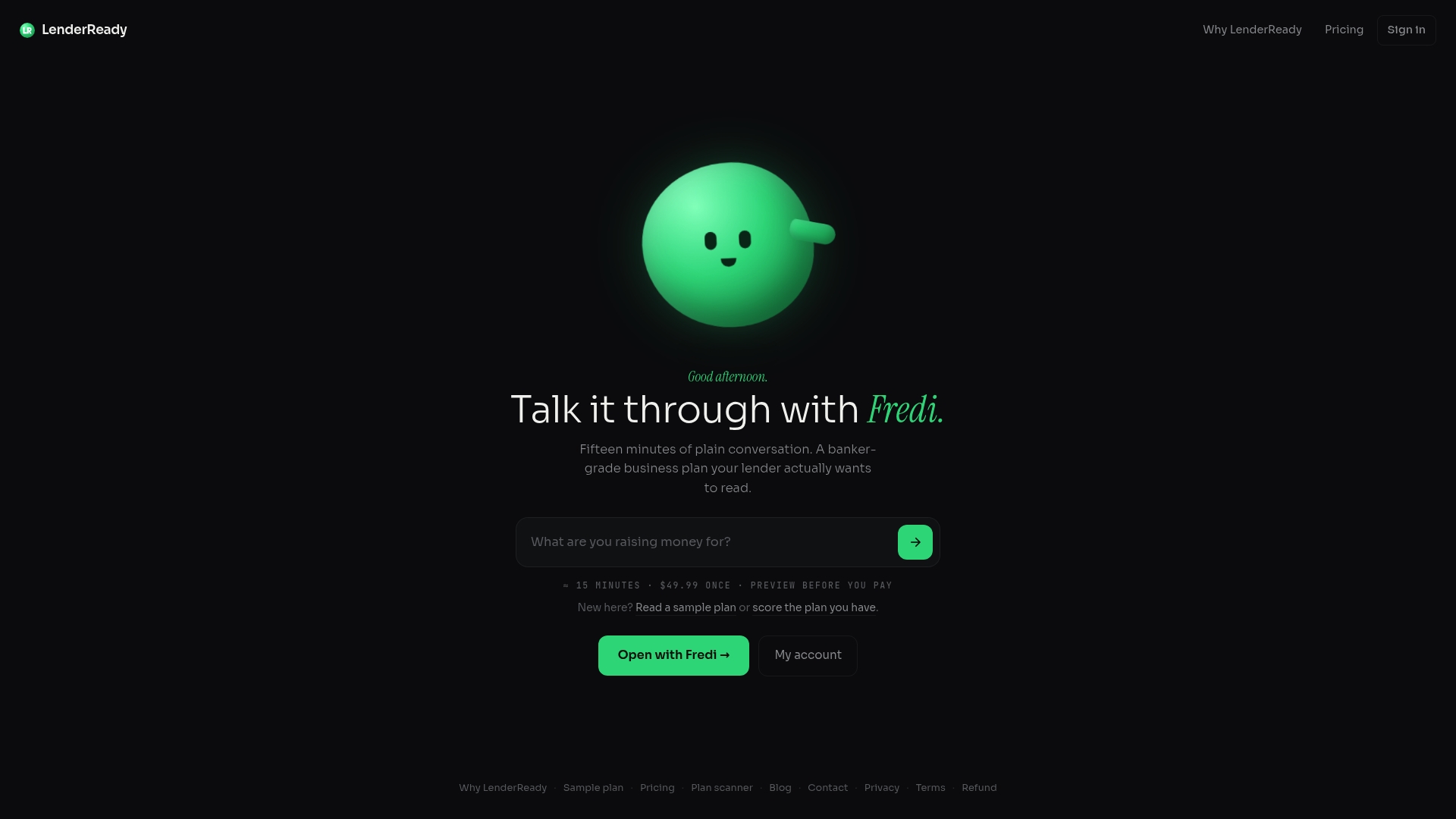
The features that matter most for a loan proposal are built in: a one-page loan summary, traceable assumptions, a downside scenario, and an optional paid review by a human banker who has sat on the other side of the credit desk. The free plan readiness scan lets you check your proposal against lender criteria before you submit, so you are not discovering gaps after the fact.
For Canadian entrepreneurs applying to chartered banks, credit unions, or BDC, the output is structured to match what those lenders expect. If you want to see how it compares to building a plan with a general-purpose AI tool, the ChatGPT vs. LenderReady comparison lays out the difference in plain terms. Start there, run the free scan on your current draft, and you will know exactly what to fix before your next lender conversation.
Useful sources for Canadian loan proposal preparation
The sources below are the most authoritative starting points for Canadian entrepreneurs preparing a loan proposal. Each one serves a specific purpose in the process.
-
BDC: How to prepare a winning business loan proposal:: The most directly applicable Canadian source. Covers recommended structure, plain-language guidance, and length expectations for comprehensive requests. Start here.
-
Shopify: How to write a business plan for a loan:: Useful for understanding standard business-plan sections and how to frame the funding request and financial plan within a broader plan structure.
-
NerdWallet: How to write a successful business plan for a loan:: Best for projection and modelling expectations, particularly the 3–5 year annual and 12-month monthly cash-flow requirements.
-
SBDC Tampa Bay: Sample Loan Proposal:: A US-origin sample, but the organisational format and itemised financial schedules translate directly to Canadian lender expectations. Use it as a structural model, not as a source of Canadian-specific program information.
-
PandaDoc: Free Bank Loan Proposal Template:: Best for layout and table of contents. Download it for the structure, then replace every example figure with your own verified numbers.
-
Loan Analytics: Feasibility studies, business plans, and investment memos:: Explains how banks use proposals to build credit memos and what analysts focus on. Useful for understanding the lender’s internal workflow and framing your risk-and-mitigation section accordingly.
-
BMO: Creating a financial proposal:: A bank-side checklist that lists the exact documentation and information a major Canadian chartered bank expects. Cross-reference your appendix against this list before submission.
-
Wiley: Appendix B: Sample Business Plan and Loan Proposal:: A textbook-format complete sample covering narrative sections, financial schedules, and suggested source attachments. Useful for seeing what a submission-ready document looks like from first page to last.
This article provides general information about loan proposal preparation and is not a substitute for professional financial, legal, or accounting advice. Lending requirements, program terms, and eligibility criteria change regularly. Confirm current requirements with your lender or a qualified professional before submitting any application.
See where your financing file stands
Fifteen questions, four minutes, no documents and no email. You get a readiness stage, the gaps a lender would raise, and the document list for your request.
Check my readiness, freeLenderReady is an educational service, not a lender, broker, or financial advisor. Lending criteria vary by institution and change over time; treat this as a starting point, not a guarantee.