Startup Funding in Canada: Your 2025–2026 Guide

What startup funding options are available in Canada?
Canadian entrepreneurs have access to one of the more varied public funding ecosystems in the world. Government grants, repayable loans, tax credits, and specialized programs for underrepresented founders all exist at the federal, provincial, and municipal levels. The challenge is not finding money but knowing which door to knock on first.
The main categories break down like this:
- Grants: Non-repayable funds from government or non-profit sources, often tied to specific sectors, demographics, or activities like research or export development.
- Government-backed loans: Programs like the Canada Small Business Financing Program (CSBFP) offer government-backed loans for startups with under $10 million in annual revenue, with lenders sharing the risk with the federal government.
- Tax credits: The Scientific Research and Experimental Development (SR&ED) program refunds a portion of eligible R&D spending, making it a quiet favorite among tech founders.
- Equity financing: Angel investors and venture capital funds take an ownership stake in exchange for capital, typically entering after early government or grant funding.
- Specialized programs: Futurpreneur targets entrepreneurs aged 18–39, including dedicated streams for Black and Indigenous founders. Startup Canada runs programs for women-identifying founders and underserved entrepreneurs. The Native Commercial Credit Corporation offers financing built specifically for Indigenous business owners.
The funding escalator model describes how most startups progress: personal savings first, then government grants and loans, then angel capital, and eventually venture capital as the business matures and de-risks.
How do Canada’s top startup funding providers compare?
Five programs and organizations cover most of what early-stage Canadian founders need, each with a distinct focus and funding structure.

| Provider | Type of Funding | Max Funding Amount | Eligibility | Target Entrepreneurs | Additional Extras | Rating |
|---|---|---|---|---|---|---|
| Futurpreneur | Startup loans | Up to $75,000 | Ages 18–39, Canadian residents | Young, Black, Indigenous entrepreneurs | Mentorship, business planning, marketing resources | 4.1★ (159 reviews) |
| Startup Canada | Grants, pitch competitions | Up to $100,000 annually through the Equal Slice Program | Canadian entrepreneurs, focus on underserved groups | Women, underserved founders, early exporters | Webinars, export readiness, advocacy, Business Owner’s Toolbox | 1.8★ (6 reviews) |
| Canada Digital Adoption Program | Digital adoption grants | Varies by stream | Small businesses adopting digital technologies | Startups and SMEs going digital | Technology funding assistance, digital advisor services | 3.7★ (44 reviews) |
| Industrial Research Assistance Program | Innovation and R&D funding | Varies by project | Canadian startups with technology or R&D focus | Tech and innovation-driven startups | Technical advisory, research funding | , |
| Native Commercial Credit Corporation | Loans and financial services | Not publicly listed | Indigenous entrepreneurs | Indigenous business owners | Tailored financial services and business advisory | , |
Futurpreneur stands out for any founder under 40 who wants capital paired with real mentorship. The loan ceiling of $75,000 is meaningful at the pre-revenue stage, and the Black Entrepreneur Startup Program and Indigenous Entrepreneur Startup Program address gaps that mainstream lenders rarely acknowledge.
Startup Canada operates differently. Its Equal Slice Program distributes $100,000 in annual grant funding, and its Startup Women and Startup Global programs give women founders and early exporters structured help beyond just money. The pitch competitions also create visibility that a loan never provides.
Canada Digital Adoption Program is the right fit if your startup’s growth depends on adopting new software, e-commerce infrastructure, or automation tools. The program connects eligible businesses with government funding and a digital advisor who helps build an adoption plan.

Industrial Research Assistance Program (IRAP) is the go-to for technology-focused startups. IRAP provides both financial contributions and access to technical advisors, making it particularly useful for founders building products that require R&D before they can generate revenue.
Native Commercial Credit Corporation offers financing and business advice tailored to Indigenous entrepreneurs, filling a gap that standard bank lending and most federal programs do not address adequately.
How do you choose the right startup funding in Canada?
Matching your funding source to your actual situation saves months of wasted applications. The wrong program is not just a rejection. It is time you could have spent building.

Start with your stage. Pre-revenue founders rarely qualify for bank loans, but they often qualify for grants, IRAP contributions, or Futurpreneur loans. Founders already generating revenue have more options, including the CSBFP, which requires lender approval but offers up to $1.15 million.
Know your repayment tolerance. Grants are non-repayable but competitive and slow. Loans are faster but add debt. Government-backed loans under the CSBFP can include up to a 12-month principal payment deferral, which helps preserve cash flow in the early months.
Check demographic eligibility first. If you qualify for Futurpreneur, IRAP, or a provincial Indigenous business program, apply there before going to a general lender. These programs exist precisely because standard financing underserved these groups, and they are designed with that in mind.
Understand the timeline. Grant applications typically take 60–120 days from submission to decision. CSBFP loans move faster because financial institutions handle approval, but they still require a complete business plan and financial projections. IRAP decisions depend on project complexity and advisor availability.
Pro Tip: Apply to multiple non-competing programs simultaneously. A Futurpreneur loan and an IRAP contribution are not mutually exclusive. Many funded startups stack government funding before approaching angel investors.
Avoid these common mistakes: submitting a generic business plan not tailored to the specific program’s criteria, underestimating the documentation required, and applying for funding amounts that do not match your demonstrated need.
What provincial and regional startup grants exist across Canada?
Federal programs get most of the attention, but provincial and regional funding often moves faster and targets local economic priorities more directly.
- Ontario: The Ontario Centre of Innovation funds R&D-intensive startups, and the Eastern Ontario Development Program extrass rural entrepreneurs. Toronto’s MaRS Discovery District connects founders with both capital and advisors.
- Quebec: Investissement Québec offers loans and equity financing for Quebec-based startups, with specific streams for tech companies and exporters. The Native Commercial Credit Corporation also operates with a Quebec focus for Indigenous entrepreneurs.
- Alberta: Alberta Innovates funds technology and life sciences startups, with programs covering proof-of-concept through commercialization. The Alberta Indigenous Opportunities Corporation provides financing for Indigenous-led projects.
- British Columbia: Innovate BC runs programs for tech startups, including the Ignite program for early-stage companies. The BC Indigenous Business and Investment Council backs Indigenous entrepreneurs across the province.
- Atlantic Canada: The Atlantic Canada Opportunities Agency (ACOA) funds startups and small businesses across New Brunswick, Nova Scotia, PEI, and Newfoundland, with a focus on regional economic development and export growth.
Regional economic development agencies are worth contacting directly. They often know about programs that are not well advertised nationally, and they can point you toward municipal grants that federal databases miss entirely.
Why a strong business plan is the real unlock for Canadian startup funding
Every serious funding conversation starts with a business plan. Not a pitch deck. Not a one-pager. A document that shows lenders and grant reviewers exactly how your business makes money, what the market looks like, and what happens to your numbers under different scenarios.
Government-backed loans like the CSBFP require lenders to assess your risk profile, and a weak plan is the fastest path to a decline. Lenders look for clear revenue assumptions, documented financial modeling including debt service coverage, and evidence that you understand your market. Successful funding applications consistently share one trait: the business plan is tailored to the specific program’s criteria, not recycled from a previous application.
Financial modeling matters more than most founders expect. A sensitivity analysis showing how your business performs if revenue comes in 20% below projection tells a lender you have thought through the downside. That kind of rigor separates fundable plans from wishful thinking.
Pro Tip: Before submitting any application, run your business plan through a readiness check. LenderReady offers a free plan scoring tool that flags gaps in your financial model and assumptions before a lender or grant reviewer does.
AI-powered business plan tools have made this process significantly faster. A founder who once spent weeks drafting projections can now generate a structured, lender-ready plan in a fraction of the time, then focus energy on refining the assumptions rather than building the document from scratch.
LenderReady builds your funding application’s foundation
Most Canadian founders spend weeks on a business plan that still gets flagged for missing financial detail or unclear assumptions. LenderReady takes a different approach.
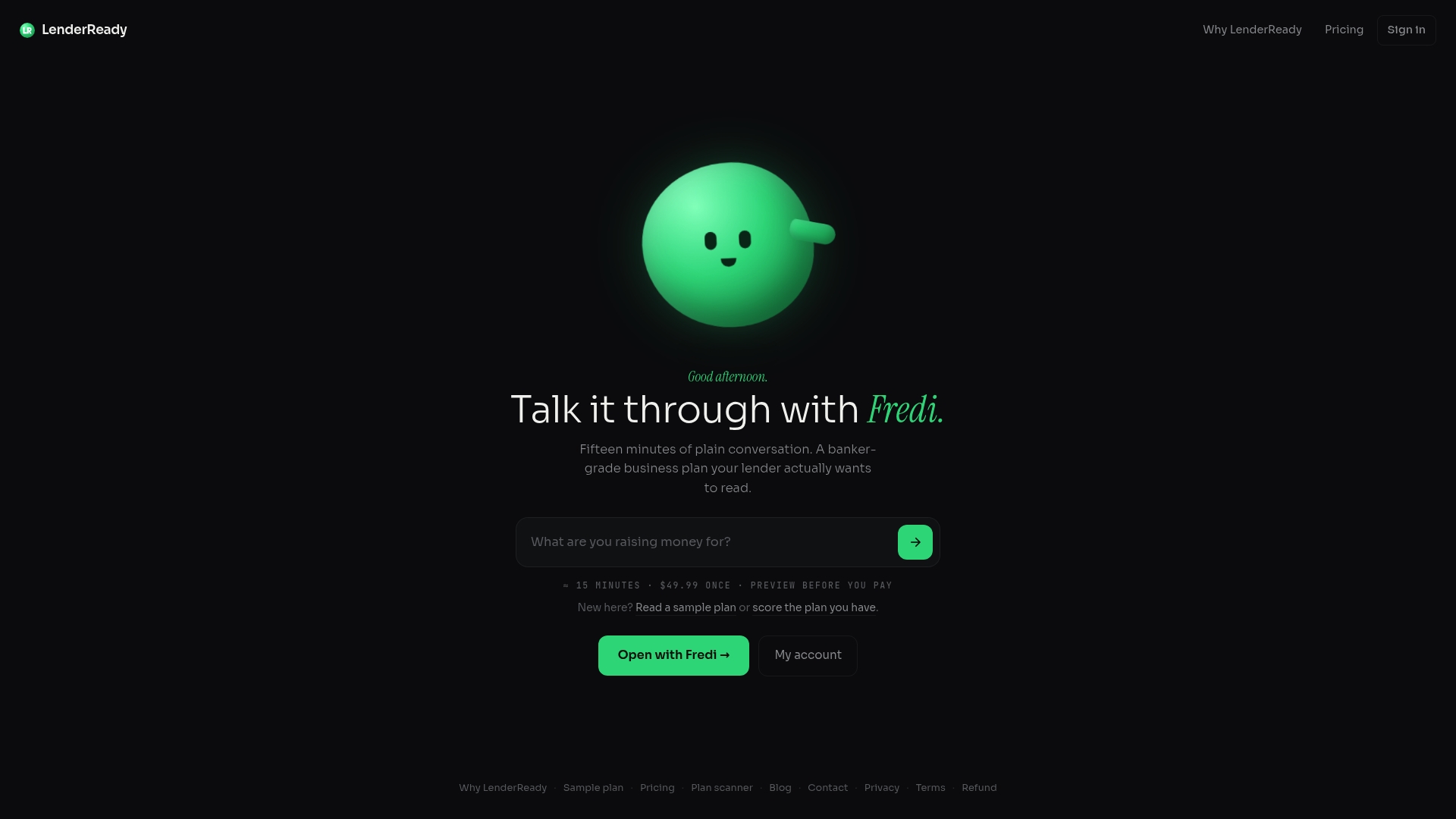
Through a short conversational Q&A, LenderReady’s AI generates a complete, lender-ready business plan in about 15 minutes. The output includes rigorous financial modeling, DSCR calculations, sensitivity analysis, and documented assumptions. That is the level of detail the CSBFP, Futurpreneur, and IRAP reviewers actually want to see. Founders can run the free Business Plan Check first, then use the Financial Statement Scan when real operating evidence is available. If you are preparing to approach any of the programs covered here, start with your plan before you touch the application form.
Key Takeaways
Canada’s startup funding ecosystem rewards founders who match the right program to their stage, eligibility, and business plan quality before applying.
| Point | Details |
|---|---|
| Government loans go up to $1.15M | The CSBFP offers up to $1.15 million for startups with under $10 million in annual revenue. |
| Specialized programs fill real gaps | Futurpreneur offers loans up to $75,000 for founders aged 18–39, with dedicated streams for Black and Indigenous entrepreneurs. |
| Grants can reach $100,000 annually | Startup Canada’s Equal Slice Program distributes $100,000 in annual grant funding for underserved entrepreneurs. |
| Stack programs strategically | Government grants, loans, and IRAP contributions are often combinable before approaching angel or venture capital. |
| LenderReady accelerates applications | LenderReady generates a lender-ready business plan with full financial modeling in about 15 minutes, reducing the most common reason for funding declines. |
See where your financing file stands
Fifteen questions, four minutes, no documents and no email. You get a readiness stage, the gaps a lender would raise, and the document list for your request.
Check my readiness, freeLenderReady is an educational service, not a lender, broker, or financial advisor. Lending criteria vary by institution and change over time; treat this as a starting point, not a guarantee.